Payback: Straight Up (2006)

yt7y8f5cgcvr9r92vkyxkgugiq0

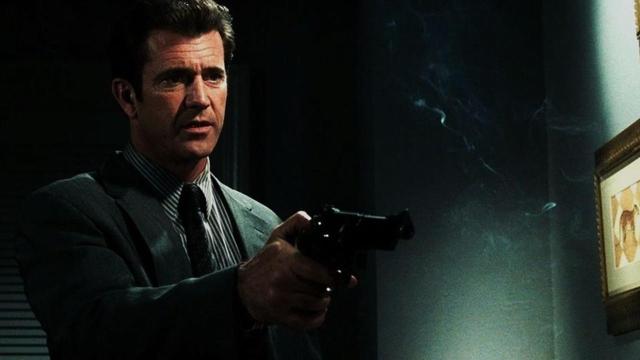
The original Payback was one of my most beloved VHS tapes in my pre-teen days and I always remember it fondly. Mel Gibson was my favourite movie star for a long time and even now I find most of his pre-controversy performances extremely charismatic and engaging. Since everything went to shit for him he seems to carry the weight of the world on his shoulders. This might be the last quintessential Mel Gibson performance we got and his turn as Porter remains one of my favourites in his expansive rogues gallery.

Payback: Straight Up – Helgeland’s recut version, reinstating his original vision for the film – is leaner and more cynical than Gibson’s theatrical cut. It is truer to the source novel (it’s based on the same book that inspired Point Blank) and is far more noirish in its sensibilities yet it lacks a certain punch. I actually prefer the original cut and find Gibson’s additions – the voice over, desaturated colours, comedic flourishes, bombastic score and differing third act – improvements over Helgeland’s choices. There’s nothing here anywhere near as memorable as the hammer sequence in Gibson’s cut. Helgeland’s version might be more cerebral and intelligent, but the original Payback is far more entertaining and visceral. Most seem to prefer Helgeland’s cut but not me. Maybe my opinion would differ if I saw them in alternate order, but I think the original film is so burnt into my conciousness that to see it any other way just feels wrong.

Payback isn’t even an especially great film in either incarnation and I haven’t seen it in any form for well over a decade yet I could still remember it practically word for word. Isn’t it funny how the films you loved as a kid never really leave your memory? I’ve seen countless greater films many times in the subsequent years yet I can’t quote them as effectively as I can this. That sounds like a party trick: “I’ve seen The Third Man five times but I can quote every line in Mel Gibson’s Payback

Posted in Movies Watched In 2016, Reviews | Tagged , , , , , | Leave a comment

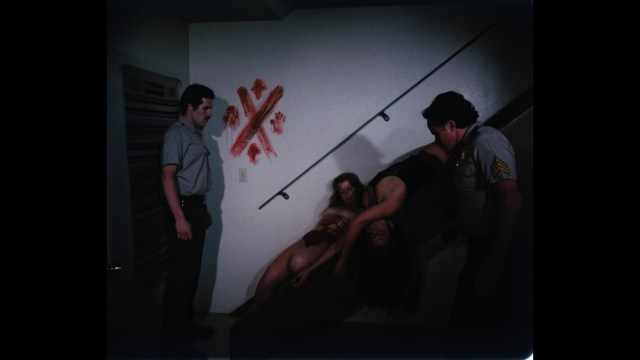
Friday the 13th Part VII: The New Blood (1988)

jason_hodder

Essentially Jason vs. Carrie, Friday the 13th Part VII is an important entry into the series for a few reasons. First off, the filmmakers needed to juice up the formula in order to compete with rival franchise A Nightmare on Elm Street. Simple stalk and slash sequences were no match for the elaborate and surreal dream fantasias which backdropped Freddy’s kill count. Their solution was to feature a telekinetic girl as the hero. The transition into this more heightened territory is surprisingly smooth and while the logic is a tad shaky, it all leads to an explosive climax which features some of the best special effects the Friday series ever had. It recalls both Carrie and The Furyin its mind-bending battle imagery and is therefore the closest we’ll get to seeing Brian De Palma direct a Jason movie.

Secondly, The New Blood also marks the first outing for Kane Hodder as Jason. Hodder is now regarded as the quintessential Voorhees and his passion for and commitment to the character is evident in any interview you read with him. Whereas Jason was previously brought to life by anonymous stuntmen to various degrees of success, Hodder was the first actor to really instill his own personality into the character. I really dig the design of Jason in this one too. The exposed spine and bone work is a great touch and makes Jason even more savage and primal than before.

The cast of teens are forgettable but final girl Tina (Lar Park Lincoln) is a series high point. It’s a shame they never carried her over into any other sequels as it feels like there’s plenty of playing ground left to cover between her and Jason. There’s an interesting subplot here involving a crazy psychiatrist meaning Jason sort of shares the title of villain for the first time. The filmmakers were clearly trying to flesh the series out into something more cerebral and complex with The New Blood and its concerns are far more mature and serious than in previous entries. It kind of works and kind of doesn’t. I’m not sure how the timeline works out either. The prologue suggests that Tina was only a little girl while Jason was sunk into Crystal Lake in Jason Lives meaning this one jumps ahead at least ten years but that is never mentioned or picked up on. Weird. Surely it would have made more sense for Jason to have been submerged between Tina’s dad’s drowning and the start of this film? Who knows.

I was never really fond of this one in the past but from watching the entire series again it actually holds up extremely well. The special effects are effective and there is more imagination in the storytelling to notch it up from many other Fridays. It’s no Freddy film and never reaches the entertaining heights of Jason Lives but hats off to the filmmakers for at least trying to stay relevant seven chapters deep.

Posted in Movies Watched In 2016, Reviews, Rewatch | Tagged , | Leave a comment

Tabu (2012)

tabu-2012-001

An evocative blend of old-school movie techniques dating all the way back to the silent period. After all this is a reimagining of the Murnau’s seminal Tabu. Miguel Gomes’ rendition is like a beautiful and poetic pop song of 1960s world music. It has countless “oh wow” images and a sly sense of humour which go a long way in breaking down its art house aesthetic into something far more accessible and stylish. I want the soundtrack. I’m also now totally game for Gomes’ thee part Arabian Nights epic.

Posted in Movies Watched In 2016, Reviews | Tagged , | Leave a comment

Satan’s Blade (1984)

satansbladebr-03

Aesthetically and conceptually Satan’s Blade is a piece of shit. It’s a slasher film that has 60 minutes between slashes and is full of dopey logic and amateur stylings. It makes you wonder why films like this have such devoted followings and deserve lavish home video restorations like the one Arrow Video have just provided for this film (how I saw it). Everything about Satan’s Blade is way below average.

However…

I liked this film quite a bit. Interestingly, it was shot mid-1980 which dates it before the first Friday the 13th meaning it wasn’t following some kind of formula. The similarities – woodland killer, cabins – are merely coincidental. It has a pretty amazing first ten minutes too. The film starts with a bank robbery for some reason and packs enough fake outs and double bluffs into its initial moments most films of this ilk fail to achieve in 90 minutes. As soon as that’s over, it becomes something far more familiar and, as I stated above, there’s a hefty middle sequence that is kill-free and full of dead air.

Still, it has that shitty 80s horror aesthetic that I really love (bunch of amateurs taking a camera into the woods and just figuring shit out there and then; do or die!) and there’s a memorable piano motif for a score which feels both corny and charming. There’s some unusual touches, like a pair of married couples in their 20s in the core group of protagonists and odd side characters (notice the motel owner with a broken arm). The killer is also amusingly vague for the majority of the running time. Little more than a pair of gloved hands reaching into frame and misplaced POV shots (Argento this guy aint), you never get a sense of threat from the killer. When their identity is revealed and the mythology around them clarified, at first you can’t help but laugh and find it fucking ridiculous but after a few minutes I actually found it pretty cool.

I have a soft spot for movies like this. As shitty as Satan’s Blade is, if this avoided being stuck on the shelf and was released either the same year or immediately after Friday the 13th it would probably held in higher regard, but coming out when it did as the genre was starting to wear thin, it was just too little too late. Watching now though, you can appreciate its very slim merits and look past its endless flaws. If you’re an 80s slasher nut, there’s just something about this film that is hard to deny.

Posted in Arrow Films, Movies Watched In 2016, Reviews | Tagged , , | Leave a comment

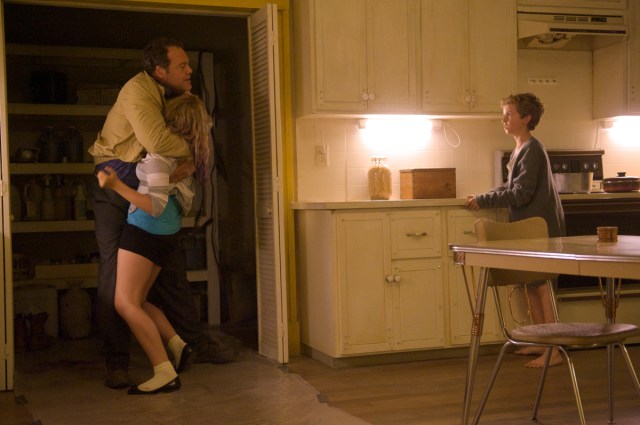
Chained (2012)

chained-movie-vincent-donofrio-dancing-kitchen-rabbit

A nasty and uncomfortable viewing experience but intentionally so. Chained has a pair of terrific performances for such a low-rent genre flick: Vincent D’Onofrio is suitably vile as the serial rapist and murderer Bob, and Eamon Farren is equally effective as Rabbit, the teenage boy he kidnaps to assist him in the crimes. It’s this unorthodox dynamic that lies at the dark heart of the movie and it works best when it digs deep into the minutia of their routines. There is also lots of disturbing behavioural detail. For instance: to pass the time, the two play a card game with the driver’s licenses of their victims and when Rabbit is of age, Bob encourages him to rape and murder a girl of his own.

The film doesn’t pull any punches and writer/director Jennifer Lynch (daughter of the more famous Lynch) isn’t afraid of going too far if the material demands it. The violence, both sexual and otherwise, is repulsive and ugly. It’s one of those films that makes you want to take a bath afterwards but there’s something to be said for that kind of visceral impact. Chained becomes less interesting the further it goes on as the inevitable subplot of escaping Bob’s lair rises to the forefront, culminating in a eleventh hour climax that really isn’t necessary or successfully executed. Still, the performance work and fresh take on a familiar set-up makes it worth watching. This is easily pre-Daredevil Vincent D’Onofrio’s best character performance since Men In Black. He’s one of those actors who isn’t afraid of committing himself totally to controversial material, which I really respect and appreciate.

I still haven’t seen a Jennifer Lynch movie that has totally knocked me over, but her handle on excessive, distressing genre is pretty exciting to behold. If Room was a little too sugary sweet for your palette, Chained is probably the film for you.

Posted in Movies Watched In 2016, Reviews | Tagged , , , , | Leave a comment

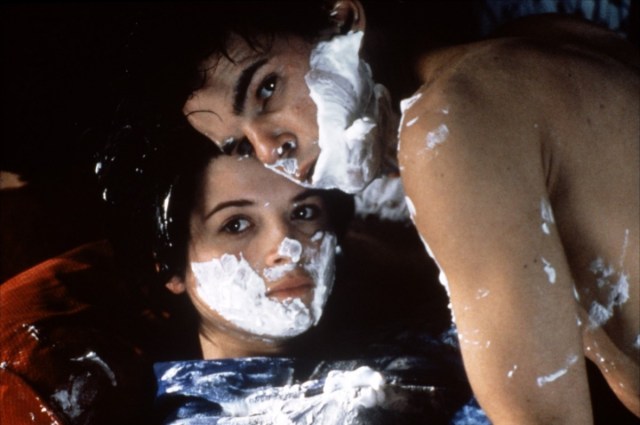
Mauvais Sang (1986)

mauvais-sang-1

My second Leos Carax film following Holy Motors back in 2012. It’s been a long time coming. A titan in the rarely-discussed “cinema du look” movement from France, Mauvais Sang is a spectacular film to behold. Stylistically individual with a genre sensilbiity which combines tropes from both crime and romantic cinema, it’s quite the cocktail.

Like the films of fellow countryman Jean Pierre Jeunet, Mauvais Sang exists in its own bizzaro universe. The crux of the story involves a heist to steal a serum that can cure a deadly sexual disease. It’s set in the future but isn’t showy about it in the slightest. The technology and architecture doesnt feel futuristic, but it does feel distinct. In fact, I feel that Carax only really set it years ahead so he could play world-builder without scrutiny. The film’s backdrop is beautifully designed and imagined.

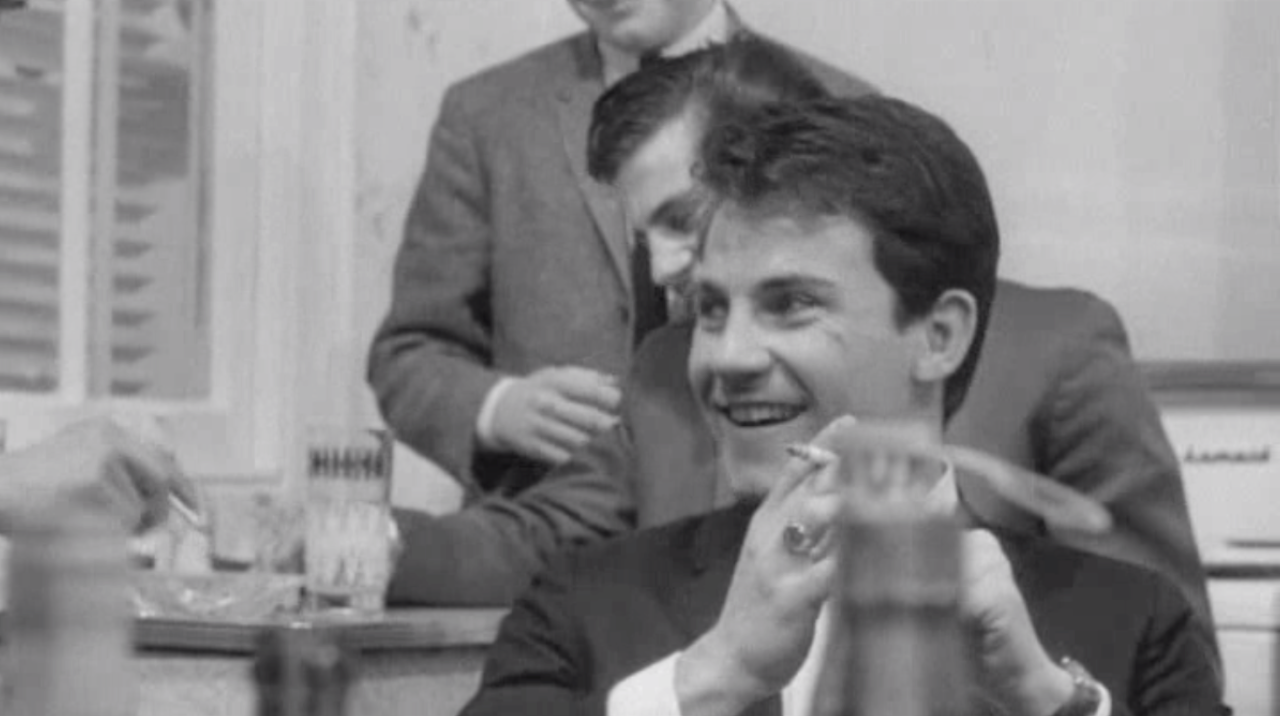
I kept having to remind myself this movie came out in 1986 because of how modern and fresh it feels (hey, maybe it did look futuristic in ’86!) It doesn’t look too dissimilar from something that could have been made ten or even five years ago. The presence of future belles of french cinema, Juliette Binoche and Julie Delpy, is quite lovely. They both look so young and fresh faced, each wielding a feminine style and badass swagger that is somewhat iconic. The real star, of course, is Denis Lavant. Working for the second time with Carax, he turns in a magnificently physical performance. Part-circus clown, part silent movie star, he is never anything less than captivating and unpredictable. The guy flips a car over with his hands for crying out loud. Just having Lavant at the centre of this film, with his unique approach to performing, makes it a true revelation. The race through the streets to Bowie’s “Modern Love” is one of those movie moments that just cements itself into your very being the minute you watch it. It’s no surprise the sequence has been endlessly quoted in subsequent films from Baumbach’s Frances Ha to Joel Potrykus’ Buzzard. The original, however, is still the best.

I was rather enchanted by this film. The story of romance in a harsh modern world is expertly rendered and is peppered with countless inventive gestures of love and kindness (Lavant carrying Binoche over his shoulders to save her the pain of burning her feet on hot cement is a heart warmer, as is their shared shaving session) as well as moments of blunt, film noir darkness. It feels representative of that special allure only cinema can accomplish and Carax is clearly a man besotted by film and film history. It is very, very French in that regard but also very, very good. Almost everything about Mauvais Sang manages to be a mini-revelation. Très bien!

Posted in Movies Watched In 2016, Reviews | Tagged , , , , | Leave a comment

The Character Study: Kenneth Lonergan’s Margaret (2011)

anna-paquin-in-margaret-2011-large-picture

At one point in Margaret, a character screams in another character’s face: “We are not supporting characters in the fascinating story of your life!” In a film so densely populated, not just with characters, but with ideas, themes, tones and aesthetic, that one line manages to cut to the heart of everything by being both ironic and appropriate. There might be one character at the centre of it all but in the bigger picture she is merely the pebble tossed into the pond allowing for writer/director Kenneth Lonergan to study the expanding ripples in the fascinating story of her life.

Lonergan’s follow up to You Can Count On Me has one hell of a checkered past. Originally shot in 2005 but stuck in a post-production limbo wrought with lawsuits for six years, the film was quietly released in the last quarter of 2011 to the kind of critical acclaim that usually fades away into hyperbole, but in this case, felt genuinely sincere and passionate. Positive reviews are one thing, but critics actually banded together and started a petition to get the film more exposure for awards season. I remember for a short period of time at the back end of 2011 reading countless articles urging audiences to seek the film out and demanding more marketing effort from distributors and exhibitors. Despite ranking highly on many “End of Year” lists and exceptional critical support, Margaret failed to garner any awards recognition and couldn’t help but become the best film of 2011 almost nobody saw.

To complicate things even further, when the film finally arrived on home video the following year, it was presented in two cuts; the theatrical 165 minute version and an extended 186 minute cut, both of which were fully endorsed by Lonergan himself, with neither being billed as the definitive version. In a nutshell: watching Margaret is fucking hard work. It’s taken me this long, almost five years, to finally tackle it with enough time and distance for it to feel less like a chore and more like a discovery. I decided to go all-in on the longer cut, and it’s with great pleasure that I can report: it was well worth the wait.

Margaret is one of those films that simultaneously feels small and seismic. In more ways than one, it is a film about overlap. At the heart of it all is Lisa (Anna Paquin), a 17 year old student who inadvertently causes a fatal traffic accident by distracting a bus driver (Mark Ruffalo). When questioned by the police, Lisa lies about the details absolving them both of any blame. The film is obsessed with the ramifications of that decision, not just on Lisa’s life, but on all of the characters in her periphery. It is built up from a multitude of faces and voices, both familiar and fresh, as well as a collision of personalities, opinions and emotions. Lonergan isn’t afraid of digression and the film repeatedly splinters off into snapshots of other lives. At one point we catch a moment of one of Lisa’s teachers played by Matthew Broderick. All we see is a shot of Broderick from behind as two students snigger behind his back but it’s all we need to colour his world. Another scene featuring Lisa and a boy she is involved with ( John Gallagher, Jr.) captures them in a cafe and Lonergan fills the soundtrack with the overlapping conversations of all the surrounding tables. The film is full of these little brush strokes and asides which add up to a populated universe that is unconventionally through and definitive. We never forget that we are following just one thread in a world of infinite stories that constantly intersect.

The film boasts a swarming ensemble of actors, ranging from one-scene cameos to extended supporting roles regardless of star status. In the same way the film treats emotion in varying extremes – big moments are downplayed, small moments are dissected – name actors like Ruffalo, Matt Damon or Broderick might only occupy one or two scenes while lesser known faces are given greater emphasis. Yet there’s never a sense that anyone is trying to steal the film from Paquin. As Lisa, she owns the film for its mammoth running time by playing a character who is as unbearable as she is fascinating. Her decisions and thought process can be frustrating and often questionable, but lets not forget: Lisa is a seventeen year old girl. For teenagers, the messiness of being an emotional human being full of flaws and misplaced intent in a world full of contradictions and selfishness can be especially vivid. Experiencing somebody’s death first-hand doesn’t instantly change Lisa the way movies and fiction have taught us. The impact takes a long time to gestate and when it finally emerges, Lisa’s guilt materialises with an unfortunate agenda: she takes it upon herself to ruin Ruffalo’s life.

It’d be easy to label Lisa as a purely selfish character but there’s so much more going on here. From Lonergan’s grand-canvas approach to Paquin’s jaw-droppingly complex performance, Lisa is deeply scrutinised. Yes, her motives come from a selfish place but more than anything Lisa seems driven by a belief that the guilty should be punished. Sadly, in the real world, as complicated and morally grey as it is, this belief is sorely misplaced. Lisa contacts the dead woman’s family and instigates a legal case on the stipulation that Ruffalo’s bus driver be fired and prosecuted. When a large cash settlement is offered instead, to the family’s approval, Lisa goes into meltdown and refuses to accept anything other than merciless retribution.

Her vicious tirade during that scene is one of the moments I keep coming back to. Paquin’s performance is consistently arresting but in this scene it all comes to a boil. Her youthful rebellion and vicious, spiteful hate seem to overflow into a defining moment for her. Lisa, like all of us, sees herself as the main character in her own story, that she is the centre of her universe. She believes that what she says matters, her actions have impact, that her very existence should be meaningful. Throughout the film she realises that this is not necessarily the case and certain things are just not in her control. “This is not an opera!” the dead woman’s best friend shouts at her. It hurts Lisa. Her quest for some kind of perfect narrative in which the good are rewarded and the bad are disciplined takes a form she isn’t prepared for or able to accept. The way the world works just isn’t good enough for her. But she’s also deranged enough to believe that everyone should sympathise with her and bend to her will, that her feelings matter to them as much as they do to her. The fact that by the end of her rant Lisa is in tears while the adults in the room look at her sadly and, from there on, abandon her, says everything we need to know. There is both something endearing and sad about her vendetta. She is as naive as she is selfish. After that scene everyone realises what is going on. This is just one seventeen year old’s way of dealing with their shit.

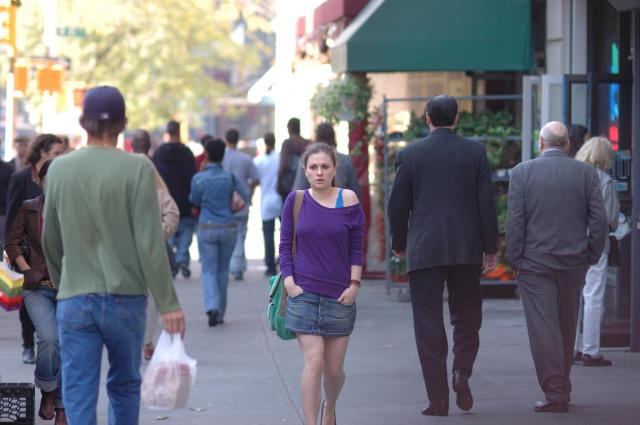
The backdrop of Margaret is the Upper West Side of Manhattan and the city is as much a character in the film as any of the actors, if not its star. Living where they do, all of these characters – predominantly upper-class, white jewish – have a certain amount of privilege which is important. Lisa’s mother, Joan, is a famed opera singer who enjoys meals in luxurious restaurants and a relatively lavish lifestyle which Lisa has simply inherited. When the dead woman’s family are offered a settlement for their grief, the money means more to them than it ever would for Lisa because money has just never been of concern to her. Lonergan’s portrait of the city in a state of post-9/11 recovery feels especially authentic and visceral. It is romanticised and affectionate, without a doubt, but not falsely presented. His decision to populate the film as he does feels like a reach to include as much of the city’s diverse personality as possible. It is as much a portrait of environment as it is humanity.

At one point a character says  “I love this view” during a rooftop date and the camera pans away to take it in, letting the audience appreciate the view for themselves. Everything drops to silence and the scene doesn’t resume until the camera returns to the characters. It is an indulgent moment but quite startling. So many scenes will begin with busy shots of crowds or bustling streets only to then focus in on its specific characters for the story to continue. Lonergan never lets us forget where and when this film is taking place. In fact, the long post-production process ultimately ended up working in the film’s favour. The end result is a period-piece where everything – from the actors to the locations – genuinely look six years younger.

As far as complicated storytelling goes, Margaret is something of a triumph. In an age where television seems to be stealing the limelight with its multi-year character arcs and ten-hour plus instalments, a film like this goes a long way to remind you just how powerful and rewarding great cinema can be. This is an artistically ambitious and novelistic work so dense with content and character that the experience of watching it becomes a complete immersion. Even at over three hours, I was transfixed and totally engaged. Unlike so many exhausting blockbusters, Margaret is a film that earns its lengthy running time by putting it to good use. The film isn’t perfect, but it carries itself with such purpose and has such clear authorial intent that even the imperfections and indulgences feel correct.

While full to the brim with exceptional acting work, Anna Paquin’s leading performance is gigantic and a big part of why the film had such an effect on me. As I have discussed, the film is many things, but when looked at as an epic character study of Paquin’s Lisa, it has the same breadth and minutia as a definitive autobiography. It feels like literature in motion. I came out of Margaret feeling like I knew Lisa intimately. She has become one of those characters for me, like Travis Bickle, who you may not necessarily enjoy spending time with but one you can’t help but think about and be obsessed by. Lonergan’s study of this girl is mighty and his formal audacity makes a much-needed case for movies being a vital and individual medium. Not only did Margaret exceed my very high expectations, it is a film that has stayed with me every day since seeing it. If I were to write a multi-volume dissection of my moviegoing experiences, Margaret is one of those films that would demand its own chapter. It may very well be one of the best films I’ve ever seen.

Posted in Movies Watched In 2016, Reviews | Tagged , , , , , , , , , | Leave a comment

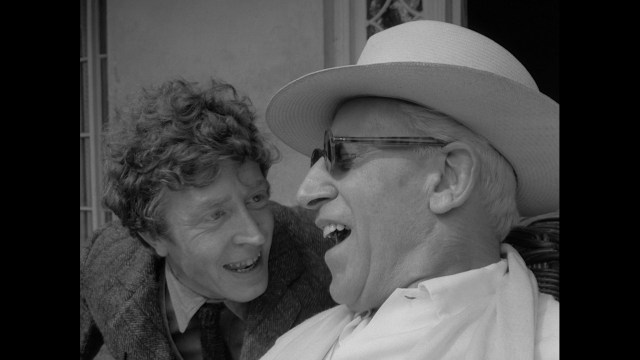
Song of Summer (1968)

kenrussell17

Hailed by Ken Russell himself as the best film he ever made, for the BBC or otherwise, Song of Summer sure arrives with raised expectations. This is the third of Russell’s BBC productions I’ve seen now and it is probably his most accomplished technically and in terms of story.

The film takes place during the famed composer Frederick Delius’ last years of life, while he was blind and paralysed. A young composer, Eric Fenby, moves in with Delius to help archive his life’s work and to assist Delius in composing new pieces. Russell’s approach here is less expressionistic and experimental than in Elgar and The Debussy Film, instead he tells a very sweet and moving story about creativity, friendship and art itself. The music is, as always, at the forefront, and Russell’s passion for the material is clearly felt. There’s a sense that with this one, Russell wanted to get out of the way of the story and just tell it in the best way he knew how.

Unlike the other two Russell BBC productions I’ve seen, this one isn’t clinical, at a distance or shrouded by aesthetic and style. It’s the most narrative driven of the three and character based. Therefore, you become involved with these people and find yourself caring about them. It’s a pretty moving little film that shows a softer, more heartfelt side to Russell’s often aggressive sensibility. I liked it a lot.

Posted in Movies Watched In 2016, Reviews | Tagged , | Leave a comment

Career Girls (1997)

x950

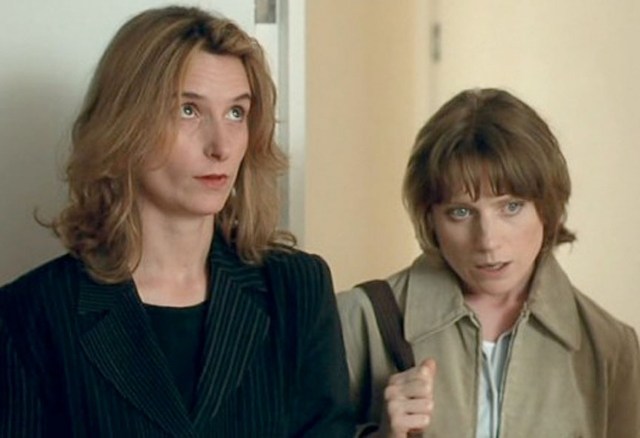
A little-seen and rarely discussed minor work from Mike Leigh, Career Girls had unfortunate timing in that it was released barely twelve months after Secrets & Lies. That film launched Leigh into the international pantheon of great filmmakers while Career Girlswent mostly unnoticed. It’s a shame because the film is very good.

Undeniably mounted on a smaller canvas, both thematically and aesthetically, Career Girls is essentially a two hander between two women as they meet up years after being University room mates. Leigh moves back and forth in time to show the two women now and in their earlier days together. It’s a study in how faces, personalities, circumstances and lives can change in very little time. It’s quite refreshing to see Leigh work with such minute materials and the film is only as broad as it needs to be. As with all his work it is wrought with moments of dark comedy, tragic reality and anchored by terrific performances. Both Katrin Cartlidge and Lynda Steadman are excellent in past and present incarnations of their characters and their little daylight forays and reminisces are beautifully played. It’s very light on its feet, almost a sunnier sister film to the apocalyptic Naked.

Mike Leigh himself is very fond of Career Girls and he’s never quite made a film like it since (does he ever repeat himself?) There’s a sense that it as much a film that belongs to the actresses as it does the director. It comes from a very feminine place and has a sisterly, motherly care running throughout. Maybe its low stakes and minor conflicts were cancelled out by Secrets & Lies‘ grand sweep, but it is a film that deserves attention in its own right. As far as B-sides go, you could do much worse than this. Any budding Leigh fans out there might leave this one until last, but they’ll be happy to find it a pleasant surprise.

Posted in Movies Watched In 2016, Reviews | Tagged , , , | Leave a comment

Mean Creek (2004)

mean-creek

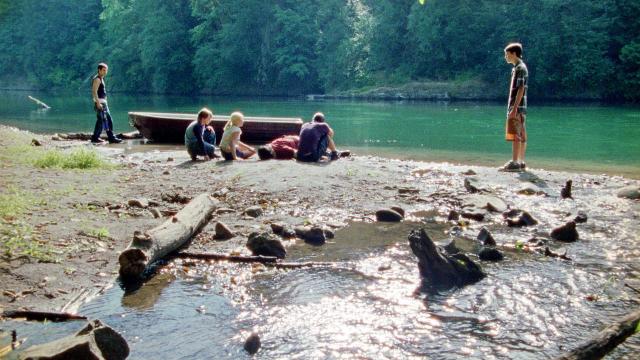
I’ve been wanting to se Mean Creek since it first came out twelve years ago which makes me feel very old. If I saw it back then, I would have been around the same age as most of the main characters. Now I’m older than all of them. Now while Mean Creekis not exactly a film that rewards such a long wait, it is a captivating little thing.

All of the young actors are good and there’s enough complexity to the characters that they aren’t just kids but more like young adults. They’re waiting for their place in the world and the angst is often overwhelming for them. The relationships feel very authentic, as does the group dynamic. Rory Culkin might be my favourite of the Culkins and I suspect this is the pinnacle of his younger performances. Josh Peck too is used very well. In fact, part of this film’s appeal to me back in the day was the idea of seeing Josh from Drake & Josh be a horrible bully getting his comeuppance. It doesn’t disappoint in that regard, even if his character is a lot more complicated than you may expect.

Maybe it’s the spectre of Stand By Me in my head but the film does have a bit of Stephen King vibe. Also Terrence Malick and Harmony Korine. It’s a film that exists in its own small-town bubble. I like the period markers (obviously they weren’t period back then) like the heavy presence of a Mini DV camera and the first signs of the digital age coming to light. It’s inherent a film set during and about 2003/2004. Jacob Aaron Estes is clearly a very cine-literate director obsessed with character and detail rather than plot so I am surprised to find he hasn’t made anything of note since. It’s a strong debut, if a bit slight overall. The second half is far less interesting than the first but it remains enticing. Not sure if I’ll ever feel the need to return to Mean Creek but this trip has definitely been a long time coming.

Posted in Movies Watched In 2016, Reviews | Tagged , , , | Leave a comment