Surface Pleasures: Nicolas Winding Refn’s The Neon Demon (2016)

7012

Jesse (Elle Fanning) is an angelic 16 year old who flies to L.A. with dreams of being a catwalk star. She becomes acquainted with two models, Sarah (Abbey Lee) and Gigi (Bella Heathcote), and a makeup artist, Ruby (Jena Malone). As politeness quickly gives way to backhanded compliments, it becomes immediately clear that the foundation for this relationship will not be built on friendship and support, but competition, ruthlessness and obsession. Sarah and Gigi proudly discuss the surgical modifications they’ve had to make themselves beautiful. They therefore see Jesse–a natural and pure beauty who also has youth on her side–as a very real threat to their throne. Only Ruby seems to have genuine affection for the new girl, but she too wields an untrustworthy eye.

Nicolas Winding Refn’s latest fantasia is a film obsessed with surface pleasures. His last film Only God Forgives was booed at Cannes for being a hollow exercise in kaleidoscopic style over substance. The Neon Demon won’t do much to win over his detractors as it too proved equally divisive at Cannes this year for its extreme artistic choices. Unlike Only God Forgives though, the lavish presentation here is more appropriate to the backdrop. The film unfolds in a dreamlike impression of the L.A. fashion world where image is queen and beauty is conqueror. Everything seems custom-fitted to present reflections and refractions: Jesse and Ruby first converse via their reflections in a dressing room, Jesse meets Sarah and Gigi in a bathroom during a lavish party where mirrors dominate every frame. It’s all there to ensure that, whether it be a wrinkle in the skin or a crack in the smile, there’s no chance of missing that first imperfection. Flawless it all should remain, with any faults to be immediately nipped, tucked or plucked away. When a boy after Jesse’s heart (Karl Glusman) challenges the concept with the age-old argument, “it’s what’s underneath that counts,” he is told: “Beauty isn’t everything. Beauty is the only thing.”

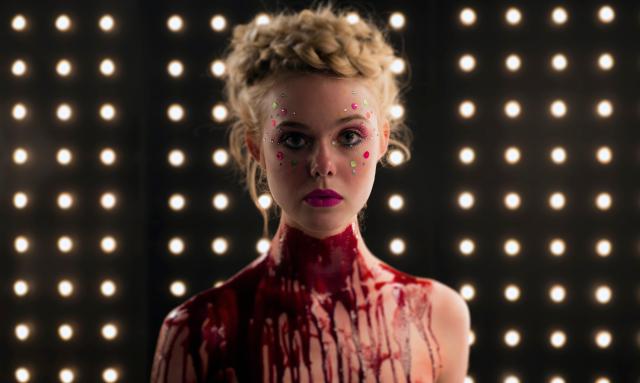
Taking cues from his recent work shooting lavish and expensive fashion commercials and working here with cinematographer Natasha Braier, Refn transforms The Neon Demon into an aesthetic dream house. The credits unfold over falling glitter as hallucinatory colors excite the eyes, while Cliff Martinez’s pulsing synth score stimulates the ears. The compositions are wide and bold, either stripped bare with voids of brilliant white or drenched in primary-color neon that Refn has proudly appropriated from Kenneth Anger, Mario Bava, and Dario Argento. In Refn’s world everything is presented as tableau. Even moments between photoshoots appear posed and choreographed. Ever since Drive, the filmmaker has been ruthlessly scaling back on dialogue, finding image to be his preferred form of communication. As a result, entire conversations seem to unfold in The Neon Demon through nothing but glances and body language. It’s fitting as models are not expected emote with their voice but impress with their body. Under such overbearing style, the performances can come across as stilted and unnatural, but with actresses as gifted as Fanning and Malone in the mix it’s clear this is not as much an artistic flaw as it is a decision.

Jesse is surrounded by women who aspire to be preserved and worshiped. They don’t only demand attention, they need it to survive. There’s a sense that some of these models suddenly found no use for a heartbeat and simply remained empty and poised. At times they look like mannequins, at others they look like corpses. Makeup artist Ruby even moonlights as a technician at a local morgue where she is responsible for sprucing up cadavers before they are buried or burned. In L.A., even the dead are given makeovers and improvements. Both Sarah and Gigi–pale blondes, like Jesse–are as ghostly as they are glamorous. Like vampires suddenly free to walk under the Hollywood sun, there is something inhuman about them. Their cruelty to Jesse reaches beyond words. There’s genuine threat and danger to them but we aren’t entirely sure why. For much of the film’s running time they seem to be blank canvases waiting to be painted on, like white snow beneath a bucket of hot blood. Consequently there becomes no doubt–this being a Refn film after all–that things will ultimately descend into some sort of grand guignol. Early on, after Jesse accidentally cuts her hand on a shard of broken mirror, Sarah tries to suck the wound dry causing Jesse to flee in terror and confusion. Similarly, Ruby becomes infatuated with Jesse and sees her virginal purity as the quench for her own sexual thirst. With these two scenes, the sinister undercurrent bubbling beneath The Neon Demon eventually rises to the surface. It is here the film fully transforms, just as Jesse herself transforms and blooms by embracing her beauty, into a fully-fledged horror film.

Sex and violence have always been obsessions for Refn but this might be his sexiest and most violent film yet. Yes, the film is painted with varying depictions of scantily-clad women and his primary emulsion is blood-red yet the visceral thrills are more complex than that, more subconscious. The film first sinks its teeth in via an unnerving sequence in which Jesse finds her squalid motel room invaded by an intruder. The intruder just so happens to be a mountain lion which has, presumably, escaped from a local zoo. Plot-wise, this scene has little to do with the rest of the movie but metaphorically, it is everything. Upon seeing the creature, Jesse faints. But the way Refn stages it, the faint appears to come from ecstasy rather than fear. Somehow, this strange moment becomes one of the sexiest in the picture. Not only does it signify Jesse’s own blossoming into a powerful creature, but there is a sexual awakening triggered by the lion’s presence; a passage of rights from girlhood into womanhood. Later on, when Jesse recounts the story of a childhood nickname bestowed upon her by her mother–“Dangerous”–you will find yourself thinking back to that lion and understanding its relevance. For the remainder of the film there is mention of a young girl–“Lolita-young,” we are told–in the room next to Jesse’s who appears to be repeatedly tormented and violated. Is this terrifying subplot to do with Jesse’s naivety and innocence being left behind for the wolves following her mutation upon seeing the lion? Or is it just another part of Refn’s provocation? I believe the conclusion is your own to make.

There are moments of repulsive beauty in The Neon Demon, and extremities so ridiculous they become glorious. For the majority of its running time the film feels like a perfume ad laced with arsenic but by the end it thrills in the way pure, down and dirty horror movies thrill. We first meet Jesse covered in fake blood posed like a Prada-clad slasher victim for a photo-shoot and by the end, naked women are showering themselves clean of the real thing. There is a glee to the violence and a humor that Refn isn’t afraid to ask his audience to indulge in and enjoy. It rewards you with the visceral experience that many felt Only God Forgives promised but sorely lacked. By the time the film is alternating between lesbianism, necrophilia and cannibalism on a scene-by-scene basis you can’t help but shrug, laugh and go along for the ride.

From his vibrant aesthetic to the divisive audience reception, Nicolas Winding Refn has always been a filmmaker of extremes. As an exercise in style, The Neon Demon soars in moments of maximalism and minimalism alike. A strobe-light performance-art sequence at the beginning of the film will push your retinas to the limit whilst simultaneously battering your local cinema’s sound system. But by the film’s end Refn knows that a simple close-up is enough to make his point heard. He avoids making a film that feels like a cautionary tale or a damnation by presenting us with an L.A. that is removed from reality, a reflection from a cracked mirror. This is another fairy tale, a twisted fever dream where beauty and aesthetics are not just hollow window dressing, but tools of delusion, destruction and despair. It is a film born from the imagination of a filmmaker who believes in cinema as a visual medium and genre storytelling as a legitimate art form. Yes, beauty isn’t everything. But in Refn’s cinema, it can be the only thing.

Review for Dim the House Lights.

Posted in Movies Watched In 2016, Reviews | Tagged , , , , , , , , | Leave a comment

Hana-bi (1997)

hanabidl2

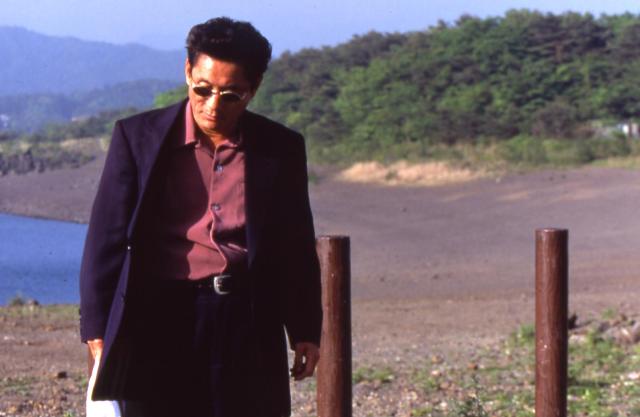
I’ve seen a few odd Kitano movies here and there but this one feels like the real deal. There’s a cut early on, from the flame of a lighter to the explosion of a gunshot, that really made me sit up and take notice. The mode of direction here is spartan, expressionistic and blunt. It’s one of those films where everything feels deliberate, the work of a director in command of his technique. I haven’t seen every film Kitano directed leading up to it, but Hana-bi certainly feels like a first masterpiece.

Like most of Kitano’s signature movies, Hana-bi is about a violent man in search of a soul. Nishi (Kitano) used to be a police detective, now he borrows money from the yakuza to pay for his wife’s medical bills. We get this information in drips and drabs. It is structured around memories, almost Roeg-ian in it’s fragmentation but more zen. The frame is rarely in motion but the visuals are striking enough to pierce you. Kitano frequently cuts to shots abstract artwork to convey a psychology making the film far more experimental than it may first appear. It’s seductive and mildly transcendent. The film can burst into sudden violence but it can also rest on a landscape of a peaceful sea view. Kitano’s hand is always steady and he never lets story run away with him. There are a flurry of supporting roles, but it never ceases to be about Kitano.

Reading about Kitano’s own personal troubles before he made Hana-bi (he had a motorcycle accident rendering half of his face paralysed) the film makes more sense. It is clearly made by a man who has seen his own demise in one way or another and accepts that he is not immortal. There’s a peace to this film, a knowingand acceptance of something that is present even in the most violent moments. Everything that happens feels inevitable. When a character is suddenly attacked, the cutting doesn’t become frenetic, the camera remains in position and we see the moments of silence after the violence that somehow feels more true to life than a barrage of bloody cuts. It’s a beautiful film to take in, orchestrated primarily through minor keys but it’s final impact is nothing short of major. Near enough a perfect film.

Posted in Movies Watched In 2016, Reviews | Tagged , | Leave a comment

Afternoon Delight (2013)

afternoon-delight01

Afternoon Delight is like a new spin on one of indie cinema’s most cliche’d character tropes: the stripper with a heart of gold. This one is written and directed by a woman, Jill Soloway. Here it’s not a man who comes to the stripper’s aid with delusions of “fixing” her but a married woman, Rachel (Kathryn Hahn). Taking her therapist’s advice on spicing up her marriage, Rachel and her husband, Jeff, visit a local strip club but rather than finding a spark with Jeff, she becomes enchanted by one of the strippers, McKenna (Juno Temple). One thing leads to another – the two women meet on more casual circumstances – and feeling sympathy for McKenna, Rachel lets her move in until she can get on her feet. Now, the set-up sounds preposterous but the writing and actors make it work. This is real life. Weirder shit has happened, right? Maybe. But this is also a movie, where weird shit is allowed to happen.

What I liked about Afternoon Delight was how it constantly subverted my expectations. It goes places you might expect, but gets there with characters you wouldn’t expect it from. Rachel is married with a child and McKenna is a stripper who also moonlights as a call girl. At one point in the film Rachel accompanies McKenna to see one of her clients and ends up sat in a hotel room watching McKenna have sex. The build up and pay off to this scene is brilliantly played. It’s all very casual and happens extremely naturally. It’s dark and sleazy, but clumsy and awkward. Rachel doesn’t despair and run away or try and teach McKenna to “do the right thing” because she’s too polite for that. Her fatal flaw is that she sees the best in people. McKenna might be half her age, but she is in control and Rachel envies this about her. Instead she goes along with it and has an experience. She will probably never tell her husband about it because it would likely lead to divorce. She doesn’t really do anything wrong, but she is complicit in a situation a married woman, as society tells us, shouldn’t be involved with. Finally, as the scene winds down, just like Rachel you’ll find yourself asking “how did I get here?”

Hahn and Temple are fantastic in the film. Both actresses are so good it feels like they should have become immediate stars. But not a lot of people saw the film and it polarised those who did. McKenna does eventually set off some explosions in Rachel’s life and probably triggers a few divorces but by the film’s end she remains the same character we met at the start. She doesn’t really experience any life lessons and will probably continue to make the same mistakes. It feels honest that way. Rachel and her husband manage to sort their issues out and there is something of a happy ending. There’s sweetness to go with the sour. The film is called Afternoon Delight after all. Your enjoyment of it will really come down to whether or not you respond to Jill Soloway’s voice. I did and I enjoyed it a lot.

Posted in Movies Watched In 2016, Reviews | Tagged , , , | Leave a comment

Victoria (2015)

maxresdefault

Victoria is something of a catch-22. On the one hand its all-in-one-shot gimmick heightens a rather generic thriller into a real-time feat of technical bravado. On the other, the film becomes frustratingly long-winded and meandering where it should be brisk and sudden. We have to walk from location to location, sit through tedious car journeys and generally wait for the cameraman to keep up with the characters until something is allowed to happen. Were this a 90-minute movie with smaller square footing, I think it would have been more effective. At 140 minutes it feels punishingly drawn-out.

That being said, this is still an ambitious undertaking with an admirable emphasis on character and romance. As the action is mostly limited to frenzied foot chases in the final act (assisted by some dodgy CGI gunfire), I suspect director Sebastian Schipper’s primary motivation for shooting it all in one take was either A) to give the film an irresistible marketing hook or B) to experience the budding relationship between Victoria (Laia Costa) and Sonne (Frederick Lau) in real time. These two only spend one long, hectic, tragic night together but, to quote Sarah Connor, they love “a lifetime’s worth”. At one point the unconventional pair are forced to pose as a married couple with child in order to escape police custody. The visual metaphor is hard to miss. Perhaps if Victoria and Sonne met under different circumstances, they would have no need to pretend. It’s a cheeky glimpse into the road not taken and a possible alternate version of how their lives may have panned out.

Despite the technical acrobats (which, frankly you forget about after a while) the real star here is leading lady Laia Costa. As Victoria she is incredibly watchable and authentic. You might wonder why her character makes stupid decisions but her performance really sells every choice she makes. She comes across as human and impulsive rather than dumb and incompetent. The camera might be in a constant flux of motion and adjust but thankfully the lens always finds its way back to Costa’s face. She really anchors the film and makes the bloated running time easier to digest. (Also did anyone else think she looked a hell of a lot like Bjork?)

I wish this film was better. I’m not sure the one-shot gimmick works in its favour – it never feels like anything else but that: a gimmick. I admire the ambition but I feel that the aesthetic approach hinders the story more than enhancing it. It feels like a film that’s screaming out for a breakneck pace. There were countless times when my finger was itching towards the fast-forward button just to hurry things along. It’s a film that tested my patience more than rewarding it. Luckily, the acting work and central characters kept me intrigued to see the outcome, even if the ultimate ending isn’t much to shout about. Worth a one-night-stand but when it comes to long term pleasures, Victoria is a bit of a blank.

Posted in Movies Watched In 2016, Reviews | Tagged , , , | Leave a comment

Friday the 13th (1980)

friday_13th

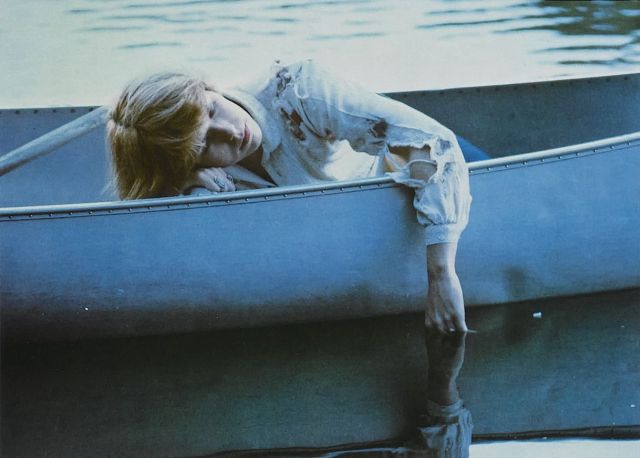
Friday the 13th was never really a good film was it? Watching it today it’s pretty indistinguishable from the countless other stalk-and-slash horror movies that emerged in Halloween‘s wake. Thanks to an impressive distribution spread from Paramount and a smart marketing campaign, however, Friday the 13th managed to rake in a shitload of money and ultimately spawn a franchise.

The acting is mostly terrible, the script is plain and the direction unoriginal. The whole thing is in sore need of some character. It’s thoroughly average and dated. In fact, there’s only three things I can pinpoint in this movie that make it worthwhile: Tom Savini’s make-up effects, Harry Manfredini’s score and Betsy Palmer. Savini was something of a rockstar himself in this genre and Friday the 13th is one of his earliest credits. Make no mistake about it, the kills are what make this movie. While Halloweenand The Texas Chainsaw Massacre put more emphasis on suggestion, sound design and the audience’s imagination, Sean S. Cunningham – perhaps realising he lacked the filmmaking brio of Carpenter and Hooper – decided to let the blood flow and wounds open right in front of us. Savini’s effects are great and the Kevin Bacon kill is still an all-timer. This is the first time I’ve revisited Friday the 13th having seen Mario Bava’s A Bay of Blood and while Cunningham and co. claim to never have seen Bava’s film or even heard of the Italian filmmaker prior to this film’s release (I believe them) you can’t help but feel they were following in his footsteps. There are kills in this movie and the sequels ripped straight out of Bava’s film. My only guess is that Savini smuggled them in undetected. He seems like the kind of guy who saw every horror movie going.

Aside from Jason and his hockey mask (neither of which are present in the original film) the one thing that defines Friday the 13th is Manfredini’s signature score. Upon rewatch I was taken aback by how unique and inspired the soundtrack is. It really makes so much of the film watchable and effective where it would otherwise be flat as a pancake. Unlike the synth sound that defined most 80s horror flicks, Manfredini instead kept things totally orchestral but instilled it without enough weirdness and organic breath to be distinctive. It’s a shrieking, aggressive score with a brilliant “ki ki ki, ma ma ma” hook that is an instant classic. Without it the film would likely have zero identity or personality. It’s no surprise that even today Manfredini’s score is getting lavish treatment on vinyl releases.

Which brings us to Betsy Palmer. This time around I was struck by how unfairly the Mrs. Vorhees subplot is played. The character is never seen or even mentioned until she literally shows up out of the blue in the third act. I kind of like this about the movie though. I don’t think I’ve ever seen Friday the 13th not knowing who the killer is so I never felt cheated by the payoff and, I’m guessing, that’s the case for most people catching up with it today. It has probably been a long time since the movie was seen as anything other than a Jason Vorhees origin story so, in a weird way, the inept plotting doesn’t really matter anyway. Palmer brings a welcome change of pace to the film precisely when it needs it and her cranked-up performance is a lot of fun. Funnily enough, this is therefore the first and last Friday the 13th movie to feature a villain with actual depth and personality. It’s no surprise that the first few sequels tried so desperately to keep her character a looming presence via flashbacks and corpses.

I was never a huge Friday the 13th fan (find me in Camp Freddy) but it’s still a franchise I enjoy very much. It’s been a long time since I revisited Crystal Lake so this rewatch was a bit of an eye-opener. As Cunningham himself has stated many times: this is not a great film and was made purely for financial gain. Yet as a case-study in how marketing, word of mouth and some visceral aesthetic USP’s (FX, score, an effective jump-scare ending) can make a film live longer than it rightly deserves, it’s worth a look. The greatest achievement of Friday the 13th is that it happened to initiate one of the most beloved and successful horror franchises of all time. Though I doubt even the hardcore fans would pick the original as their favourite. By all means and purposes, this is one of the least interesting entries in the entire series and even as a standalone horror flick it’s mostly disposable. Somehow though…the film lives on.

Posted in Movies Watched In 2016, Reviews, Rewatch | Tagged , , , , | Leave a comment

Dirty Grandpa (2016)

tumblr_nz47gl5pbf1uj9ivco1_1280

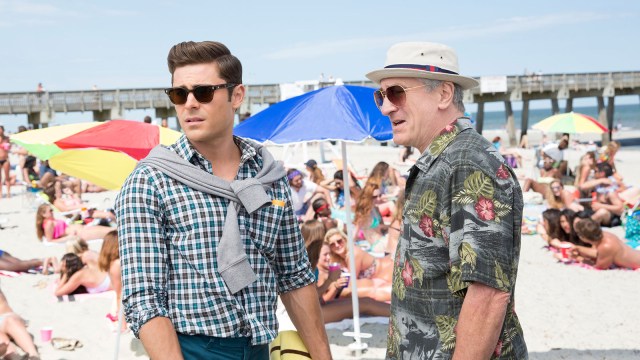
A dumb fucking exercise in bad taste and dumbassery that is almost thrilling in it’s total lack of restraint, craft and intelligence. Dirty Grandpa never ceases to be entertaining. Even bad films can be fun. But can all stupid career choices be forgiven? I wonder what De Niro saw in this script that made him think “hey, this sounds like fun”. He’s always been drawn to comedy but never in my life did I expect Bobby to be fascinated by the idea of endlessly shoving his thumb up Zac Efron’s ass.

Now I could sit here and get pissed off and lament “WHAT THE FUCK HAPPENED TO ROBERT DE NIRO?!” but the truth is, our man Bobby is actually great in this role. The problem isn’t him necessarily, it’s just that the material is a fucking bore. De Niro never stopped being a great actor and he never really stopped being in good movies, it’s just that you have to wonder why, in God’s name, is America’s greatest living actor doing this fucking drivel? Does he have a bunch of teenage kids or nephews who love Adam Sandler movies and douchebag comedies? If so, fair enough. If not, then why? Maybe we’ll never know.

It’s not just De Niro who seems to be slumming it either. Zac Efron feels miscast but I admire his desire to play a bit of a sad sack. The only problem is he’s a sad sack with the body of a greek God so it never quite gels. Maybe they went to Paul Dano first but he turned them down? Aubrey Plaza too feels like she should be spending her time on something more worthwhile. She plays the skank to end all skanks here, an honor I’m sure the filmmakers were aiming for given her atrocious dialogue but the role never really comes across as self-aware than it does stupid and infuriating. Danny Glover is also along for the ride, briefly, along with Jason Mantzoukas, Dermot Mulroney (hey, I actually buy him as De Niro’s son!) and Everybody Wants Some‘s Zooey Deutch. In short: lots of talent wasted.

Maybe Dirty Grandpa will get a cult following as the years go by. I can certainly see myself revisiting it and it’s not something I’ll forget anytime soon. That stands for something I guess. There is a sense of maximalist dirtiness and stupidity that would be completely enjoyable if the material had any suggestion of deeper intelligence, but it rarely does.

In closing, I’d like to quote my favourite joke from the Dirty Grandpa himself. In the movie’s final act, during the point when the flawed character usually bestows some wisdom to the hero, De Niro instead offers this bit of advice to the bemused Efron:

“Back in the 80s, when Andre the Giant used to go to the Playboy mansion, he’d stack five playmates on top of each other on a bed and fingerfuck them all. Five at a time, because his hands were so big”

I wonder what Scorsese thought when he saw this movie.

Posted in Movies Watched In 2016, Reviews | Tagged , , , , , , , , | Leave a comment

The Look of Silence (2015)

the-look-of-silence-adi-watching-1500-844

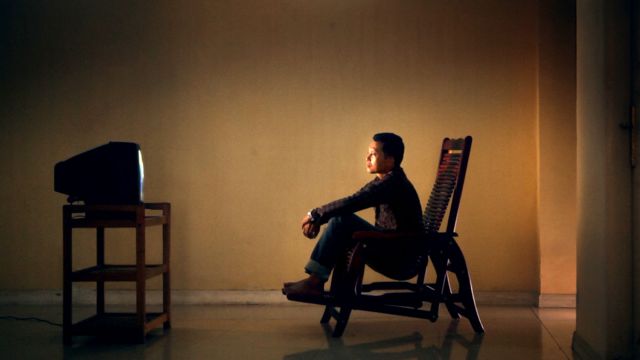
It’s one thing to see movies where the idea of “evil” is mythologized, stylized and characterized in a never-ending variety of abstractions and personifications but to actually look real evil the eye is something else entirely. That’s what lies at the heart of The Look of Silence. A man confronts those responsible for the murder of his brother, men who, even now, could have him killed without consequence if they so wished.

Every encounter in The Look of Silence is filled with dread and tension yet there’s something deeper here too. There’s a sadness and a mourning for the lives lost and a disappointment in and even a sympathy for the twisted men responsible. The souls of these men turned black long ago. While some of them have come to terms with their sins and accept whatever fate befalls them, others are being eaten away from the inside, finding that time and age is their punishment. The recounted tales of how they drunk the blood of their victims to avoid damnation are among the most chilling things I’ve ever heard.

It’s gripping stuff. Almost too real to handle and compute. A total gut-punch that is an unquestionably essential companion piece to The Act of Killing.

Posted in Movies Watched In 2016, Rewatch | Tagged , | Leave a comment

Lorna (1964)

lorna-3

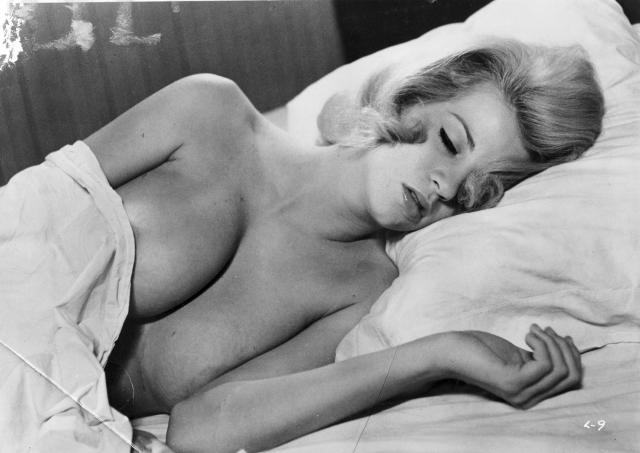
Lorna feels interchangeable with most other Russ Meyer movies but lacks something distinct. It’s the first film of his I’ve seen that I had trouble remembering the specifics of a few days later. That isn’t suggest it’s completely forgettable though.

The central performance by Lorna Maitland feels titan. Maybe not because of her acting talent but more due to Meyer’s worship-at-the-altar style direction of her. As with all his leading ladies, Meyer gives Maitland all of the best angles, all the attention and all the glory. If Lorna isn’t in a scene then characters are talking about her. The thing I always respond to in Meyer’s movies, beyond the eye-candy, is how complex his female characters are. Yes they are sexy specimens of the female form but one gets a sense that Meyer, while hunched over the typewriter, was really trying to get under the skin of these ladies and feel their insecurities, their desires and their frustrations. He didn’t just treat them as tits and ass, despite what many would argue.

Lorna is a movie about a married woman who isn’t satisfied sexually. Her “aw shucks” husband Jim, played by James Rucker, is a dope but a kind-hearted one. Lorna frequently gives him the cold shoulder because she wants a real man to sweep her off her feet. The only problem being: she lives with him on a river where real men are scarce. Lorna’s only other options are Jim’s dim-witted work mates who spend most of their time leering over her or chastising Jim. Lorna is the sole female in the movie and is lusted after by most of the supporting characters and, evidently, the director himself. In this world, Lorna’s beauty is both her strongest weapon and her biggest vulnerability. Therefore the male gaze itself becomes an oppressive force. There’s an uncomfortable sense that the always scantily-clad Lorna will soon be taken by force and, eventually, she is. This is where things get complicated.

Following her rape by an escaped convict (Mark Bradley), Lorna suddenly finds her sexual appetite satisfied and becomes besotted, even inviting her rapist into her house to play happy families while hopeless Jim is at work. As Lorna is established within the film, this makes sense. Yet the idea of presenting her rape as the answer to all her problems is still a troubling plot development. I’m not sure if it’s a bold choice on Meyer’s part or simply a naive and idiotic one. The fact Lorna so willfully dotes herself to her attacker lessens her strength in many ways, yet it’s also a human flaw that grounds her and makes her complicated. It’s a dark turn that certainly kept me watching but by the film’s conclusion Meyer fails to present any further depth that could heighten it from mere exploitation. It’s even worse being that, judging from the steamy presentation, Lorna’s rape is intended to be the film’s centerpiece of titillation. Not cool.

Beyond all that this is still an enjoyable Russ Meyer flick. It has plenty of his visual flair and nutty cutting to be aesthetically splendid and oozes a swampy, sexed up atmosphere that is, for the most part, quite fun. The only problem is that the final film is rather middle of the road and becomes quite blurry as time passes and has some plot and thematic issues which are tough to stomach. Pretty much the 1964 drive-in equivalent of Jason Reitman’s Labor Day.

Posted in Movies Watched In 2016, Reviews | Tagged , , | Leave a comment

WarGames (1983)

wargames_still8

A fun 80s cyber-thriller (the first of it’s kind?) that may have lost some of it’s modernity when watching in hindsight. I bet audiences were overwhelmed with all this tech on screen in 1983 and it felt like it was a rare peek into circuit-board culture. Now the bulky desktop computers and green-text on black screens just look pleasingly old-school and retro. The techno-babble is cool as well even if it never reaches Primer-levels of authenticity.

Broderick is perfectly cast. He looks like the kind of kid who would stay inside with computers but still be charming and dorky. This is pre-Ferris Bueller too, so the confidence of that role wasn’t hardwired into his performance (I kinda feel like everything Broderick did after Ferris Bueller’s Day Off was tainted by that character, but not in a wholly bad way). This is the first movie I’ve seen Ally Sheedy in outside of The Breakfast Club too. She’s almost unrecognizable here if you only picture her as Allison Reynolds. The chemistry between the two works. What a way to fall in love! Racing across the country trying to prevent computers initiating nuclear Armageddon. It’s also directed by John Saturday Night Fever Badham but lacks a lot of that films street-level swagger. Maybe the Bee Gees were unavailable this time.

Overall, WarGames stays afloat because of it’s a funky high-concept. The kid just wanted to play goddamn video games, he didn’t mean to start WWIII. 2001 did this much better fifteen years earlier but as a sugary-popcorn-for-the-masses alternative, it’s fun.

Posted in Movies Watched In 2016, Reviews | Tagged , , , | Leave a comment

Slowing It Way Down: Quentin Tarantino’s The Hateful Eight (2015)

THE HATEFUL EIGHT

I haven’t watched or thought about a film in the past five months as much as I have The Hateful Eight. I’ve seen it four times now and considering it’s length, it’s weight and it’s ambition, that’s a pretty substantial amount of time to dedicate to a film like this. The thing is: there’s no other movie being made in the world quite like The Hateful Eight. No-one else apart from Quentin Tarantino could dream up and get away with making this. He has got to a point now where he is in a league of his own. With total carte blanche to produce whatever the fuck he wants, Tarantino no longer seems interested in chasing perfection or delivering mere entertainment. What we have now is a filmmaker unafraid to indulge in his worst habits and limit his audience in the search for his own tempo. Tarantino has never been one to compromise or kneel before his critics. He commands a huge audience and remains, to this day, the most popular and influential filmmaker of his generation. He just so happens to use that power to make some of the weirdest and most singular American movies currently in the mainstream.

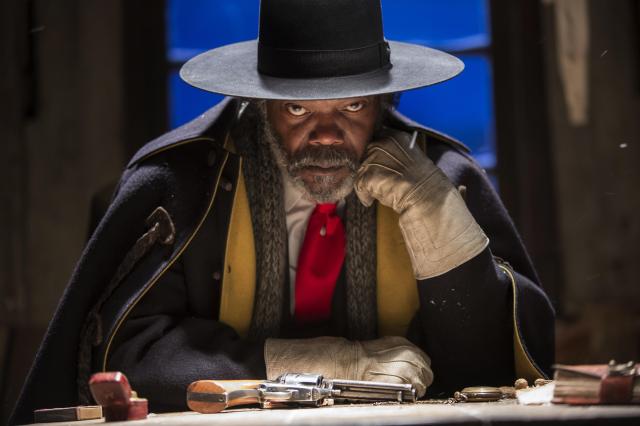
The Hateful Eight is Tarantino’s longest film to date (not counting the combined duration of both Kill Bills) and is also his most contained. Essentially unfolding in two locations; a stagecoach and Minnie’s Haberdashery; a small log cabin establishment based on the outskirts of a town called Red Rock, the screenplay feels designed for the stage as much as the big screen. There are eight main characters and a handful of supporting faces, each brought to life by a mix of Tarantino regulars and newcomers. On the stagecoach are two bounty hunters; John Ruth (Kurt Russell) and Major Marquis Warren (Samuel L. Jackson), Ruth’s prisoner Daisy Domergue (Jennifer Jason Leigh), Red Rock’s new Sheriff, Chris Mannix (Walton Gogins) and the stagecoach driver, O.B. (James Parks). At Minnie’s they find a confederate general (Bruce Dern), the Hangman of Red Rock (Tim Roth), Bob the Mexican (Demian Bachir) and the mysterious cowboy Joe Gage (Michael Madsen). Funnily enough, Minnie and her partner Sweet Dave are nowhere to be found. All of these characters boast a wicked tongue and, needless to say, none of them are to be trusted.

For three of it’s six chapters, The Hateful Eight appears to be a chamber piece about racial tensions. A monstrous blizzard keeps everyone indoors and it doesn’t take long for conversation to turn to bloody conflict. For it’s remaining chapters, the film introduces a mystery surrounding a poisoned pot of coffee (or “coffy” as Tarantino writes in his screenplay), presents us with the resolution before concluding with the bloody fallout. Plot-wise, it’s as simple as they come but thematically it is anything but and sits like lead in your belly. Simultaneously Tarantino’s most serious film and his most rambling, he expertly balances tone throughout the extensive run-time. At times it is a dissection of racial and gender politics in post-Civil War America, at others it is the blackest of comedies, embracing bad taste, crude language and offensive concepts with way more aplomb than you would expect in a film that looks this prestigious.

Shot in glorious 70mm Robert Richardson’s photography transforms close-ups into landscapes and landscapes into vistas. Considering most of the film unfolds in interior close quarters, 70mm seems like an unconventional choice but then again not much about this western is conventional. Like Paul Thomas Anderson’s The Master before it, the grand treatment heightens the intimacy to new levels. Forced to widen his compositions and slow his cutting rhythms, this is easily the classiest looking picture Tarantino has ever directed. Light and background action gain higher importance. You’ll notice dust dancing in beams of light and pay attention to every movement of each character even if they’re out of focus in the background. It is expertly directed, Tarantino has never been as meticulous with his staging and coverage as he is here. With images this crisp, everything needs to be on point and the costumes and production design are equally accomplished. By the third or fourth viewing, you enjoy certain scenes merely through appreciation of the textures of the characters’ costumes and detail in the set dressing. Did everyone catch the snow-shoes forming angel wings behind Daisy the first time around? I certainly didn’t.

The Hateful Eight is also something of a landmark in Tarantino’s filmography by the being the first to have an original score. Tarantino usually mixtape his movies using inspired jukebox cuts or choice score selections. This time around he enlists his favourite composter, the legendary Ennio Morricone, to give the film it’s own aural identity. Tarantino has had trust issues with composers before, never daring to hand his film over to another pair of hands but his gamble with Morricone pays off in spades. The maestro’s score is not only one of the best Morricone has composed recently, but one of the best in his entire oeuvre. With a career spanning over fifty years and five hundred titles to his name, that’s one hell of a compliment. I’ve worn the soundtrack out since buying it last December. I am obsessed with it. The vinyl is never far from my turntable and the mp3’s still enjoy heavy rotation on my iPod. The constant instrumentation and use of unique themes are a welcome change of pace for Tarantino and it makes the additional music – a White Stripes track, a cut from David Hess’s Last House on the Left soundtrack, as well as some unused takes from Morricone’s work on The Thing – even more impacting and deliberate. The only sound vying for more prominence on the soundtrack than Morricone’s strings is that of the characters’ voices.

Ever since Death Proof and Inglourious Basterds – my two personal favourite Tarantino films – dialogue has become increasingly important to the pulse and design of his movies. In the films leading up to Death Proof, characters discussed pop-culture and chit-chatted mainly as a counterpoint to what they were doing or thinking. There were long reams of quotable speech, no doubt about it, but it wasn’t until Inglourious Basterdsthat he really started using chatter as a weapon and as set-piece. Watching that film is to see Tarantino gain control of his talents and become something of a master with wordplay, accent and language. The dialogue doesn’t just compliment or juxtapose against the scene, it is the scene. Chances are your favourite moments in Inglourious Basterds involve little more than characters talking over a table, yet they are among the most thrilling of any film made in the past decade. He continued this approach in Django Unchained by slowing everything down in it’s final third to bubble and stew over an extended dinner scene between our heroes and the diabolical Calvin Candie. Tarantino takes that idea to it’s zenith in The Hateful Eight, essentially building an entire movie that is nothing more than extended dialogue scenes loaded with threat and tension. There’s rarely a moment here in which characters aren’t mid-conversation and more often than not, the character’s take their sweet time in reaching a point. Tarantino made a conscious decision here, as Major Warren says in Chapter Four, to “slow it way down”. For some viewers that might be the film’s fatal flaw.

Many, like myself, adore Tarantino’s writing and can enjoy it in extended doses while others prefer when he is more succinct and focused. For casual moviegoers who love Django UnchainedKill BillPulp Fiction or Reservoir Dogs – genre films which offer enough surface pleasures to please most tastes – the length and vernacular of The Hateful Eight can be punishing. Audiences waiting for action will find the characters’ constant tangents and monologuing tiresome, perhaps concluding that there is not a big enough trade-off between the two for the film to be wholly satisfying. Let’s not forget: there isn’t a single gunshot fired in the movie until well over ninety minutes in and geysers of blood don’t make an appearance until halfway through chapter four. The word “boring” has been applied to Hateful Eight more than any other film in Tarantino’s canon. It also doesn’t help that this is easily Tarantino’s coldest film to date. Not just in terms of the snowy atmosphere, but the feeling it leaves in your gut when all is said and done.

The Hateful Eight unfolds in a cold, cold west that is unrelenting in it’s savagery and prejudice. There’s an edge and harshness to the language and violence that is more hard hitting than anything Tarantino has attempted. When John Ruth vomits blood all over Daisy and punches her two front teeth out, it isn’t fun in the same way Django shooting a bunch of racist rednecks is fun, it’s outrageous but inherently brutal. The same goes for the film’s centrepiece; a story recounted by Major Warren in which he cruelly humiliated, molested and murdered General Smithers’ son, Chester. Heck, the film ends with Mannix and Warren crudely lynching Daisy before bleeding out into oblivion themselves. In short: this isn’t a Tarantino film that rewards your patience with entertaining release. It’s a visceral film, but not an obviously fun one which many viewers have found off-putting.

This is the first Tarantino movie in a while to be met with a somewhat mixed response. As with all his movies it has come under fire for it’s abundance of racist language and also it’s treatment of it’s sole female character. Personally I don’t have a problem with either issue and find their handling appropriate in regards to the material and period. The criticisms go beyond it’s controversial content and themes, however. The 70mm Roadshow Presentation (which, frustratingly, I haven’t seen) was initially plagued by technical complications and was seen by many critics as a misjudged endeavour with varying degrees of success. Speaking personally, I myself haven’t come across many people who claim to enjoy the film on the level of Tarantino’s others and found it’s languid pace self-indulgent, plodding and far too long. In fact, many declared it his worst film by a considerable margin. When I saw the film on the big screen with a semi-packed audience, I found that gauging the vibe in the room was almost as fun as the film itself. You could spot certain members of the audience tuning out while others were completely dialled in. I heard audible groans at various points and there was a general sense that the crowd was getting repeatedly restless and frustrated. About four chapters in I even saw one girl, presumably on a date, ask her boyfriend in a raised voice “why the fuck did you bring me to see this?” She spent the rest of the movie flicking on her phone, clearly counting the minutes down until she was freed. Finally, as Daisy is savagely hung she looked at the boy a final time and shook her head in disbelief. I never knew you could read regret of a movie choice in the back of someones head until that night. It should come as no surprise then that The Hateful Eight is currently Tarantino’s lowest grossing film since Death Proof and, for what it’s worth (not a right lot) retains the second lowest Rotten Tomatoes rating of his career. Is this a sign of Tarantino losing his audience? I don’t think so. He’s just refining it.

For all it’s strengths and weaknesses, there is something purely Tarantino about this movie that I haven’t felt since Reservoir Dogs. Despite it’s debt to western legends like Peckinpah and Corbucci or the allusions to John Carpenter’s The Thing and Agatha Christie shadings, The Hateful Eight might be the least referential movie Tarantino has ever made. The film lives and breathes through it’s characters first and foremost and doesn’t appear to exist in the encyclopaedic rolodex of kaleidoscopic genre heritage that, say, Pulp FictionKill Bill and Django Unchained do. Sure it employs some colourful fonts for main titles and boasts a cast and crew of genre heavyweights but this film is more interested in environment than any Tarantino movie before it and feels grounded in reality where his other films feel designed and heightened. In thinking about what keeps me returning to The Hateful Eight so frequently I have come to two conclusions. First of all it’s all the things I have spoken about above: the little things that make all great movies great, the characters, the design and the attitude as well as the nuance in the writing and performances.

Within it’s mammoth length and freewheeling conversations, there is a lot of detail to be mined. Jackson, Goggins, Leigh and Russell all put in near career-best work but it’s only on the second or third viewing that you really begin to appreciate the work of the supporting cast. O.B. becomes more endearing and sweet with every watch and Bachir’s line readings as Bob the Mexican become even more humorous. I really love Roth’s work as Oswaldo Mobray and Madsen’s turn as Joe Gage. They aren’t as immediately showy as John Ruth, Daisy Domergue Major Warren or Chris Mannix but there’s a lot going on there. Think about how elaborate English Pete Hicox’s ruse is in comparison to Grouch Douglass’. The fact he creates this English fop character says a lot about his own personality. Hicox gets into the role so substantially he even prepares a monologue about the Justice system for Ruth and Domergue just to make his act all the more convincing. Is Hicox basing his performance off of the real Oswaldo, whom, we assume, was dispatched off-screen? Who knows! But the fact I’m asking these questions shows that the film has captured my imagination beyond what’s merely on screen. Another of my favourite moments in the film is as simple as Joe Gage wrapping a handkerchief around his neck after Major Warren has stuck a knife into it. Tarantino takes the time to show Gage rid himself of one handkerchief, getting another, preparing it and eventually wrapping it around himself. This sort of inconsequential business would be cut from a shorter, more brutally trimmed movie entirely but with it intact it suggests a pride to Joe Gage we wouldn’t have had otherwise. I can’t imagine the film without it. The fact all of these characters are lying bastards brings up more questions than the film answers, which is also part of the fun. Is Chris Mannix really the new Sheriff of Red Rock? (I think he is.) Is Daisy telling the truth about the gang waiting for them back at the town? (I doubt it.) Did Major Warren really kill Chester Smithers? (I think so.) And so on and so forth.

The second thing that keeps me returning to The Hateful Eightcomes down to this: this is such an unexpected movie for Tarantino to make. In the wake of Inglourious Basterds and Django Unchained I assumed Tarantino would make something smaller and compact but not quite like this. As I mentioned earlier, the running time might be epic but the content and scope is anything but. It is two (very) long scenes and a flashback. That’s it. For me the film shows Tarantino working at a fascinating new pace and moving in a slightly different direction. Where many see it as a misstep, I see it as a conscious evolution. That evolution is worth studying. I feel the exact same way about Death Proof, a film I initially wrote off for being too chatty and too slight on the “slasher” angle that the film was marketed on. Now it has become a firm favourite of mine, endlessly re-watched, for the exact same reasons I dismissed it in first place. Sometimes the filmmakers you love are more ahead of you than you think.

Django Unchained is my least favourite Tarantino movie because it is his most traditionally plotted. It is little more than a rescue/revenge spaghetti western – an exhilaratingly entertaining and vicious one at that – but it feels slight in terms of characterisation. It wasn’t the Tarantino western I wanted after Inglourious Basterds. It was too straight forward and not surprising enough.The Hateful Eight, on the other hand, is exactlythe western I wanted after Django Unchained. I know it is a flawed film and think many of the criticisms I’ve discussed are valid. But as a cinephile and Tarantino fan with an extremely packed and eclectic media diet, this movie delivers something fresh and unusual for me that I find absolutely addictive. It’s got to the point now where I will happily put the film on in the background just to be in it’s presence for a while. I enjoy it. Sure, I notice moments which are perhaps too long, that could be cut or aren’t essential but I also realise that I don’t care. I like the film the way it is. I like the constantl wordplay, the endless tangents and enjoy that it is messy, bloated and indulgent because Tarantino’s indulgences seem to be in tune with my own tastes.

The more loyal his fanbase becomes, the closer Tarantino gets to becoming the kind of cult director he has always looked up to and stolen from. He’s far too renowned now to become as obscure as somebody like Jack Hill or Corbucci – his position in the pantheon of all-timers is cemented as far as I’m concerned – but that doesn’t mean he can’t make films that slip through the cracks to be appreciated at a later date. I know Tarantino is a populist at heart and he wants his films to be enjoyed by the biggest crowd imaginable. He is proud of his talent and influence and is happy to be embraced by populist and arthouse audiences alike. The driving creative force behind all of his movies is his ambition for a sterling legacy. Tarantino has discussed at length his desire to leave behind a solid-gold filmography for the cineastes of the future to discover. He theorises that each film should be as satisfying as the last, no matter what order they are selected. Despite what many may think, I don’t believe that The Hateful Eight will be the dud that breaks the streak. It might be his worst film in terms of restraint when it comes to pacing but it is easily his best in regards to his craft confidence as a filmmaker. With time and distance I think this will be seen as one of his boldest and most uncompromising works. It’s one of the most interesting American movies made in this decade and one I am still trying to unravel and dissect. It is already one of my favourites.

Posted in Movies Watched In 2015, Movies Watched In 2016, Reviews, Rewatch | Tagged , , , , , , , , , , , , | Leave a comment