Basically Carrie by way of Patrick, Lucio Fulci’s Aenigma is in no way as bad as late-career Fulci led me to believe. Despite taking influence from many better films (Argento’s Phenomena also come to mind), this story of a girl in a coma who possesses the new girl in town to get revenge on her bullying school mates is utterly bonkers and nonsensical – just how Fulci likes it – but is a lot of fun.
Containing a slew of striking imagery and dynamic shots (look at the way the camera recedes out of the ceiling of the hospital and into a grand aerial shot of the town before settling back down at the girls school), here we find Fulci flexing his muscles a little bit. With special effects and cinematography also credited to the director, his fingerprints are certainly all over this thing. As far as the batshit meter goes, the set pieces do not disappoint.
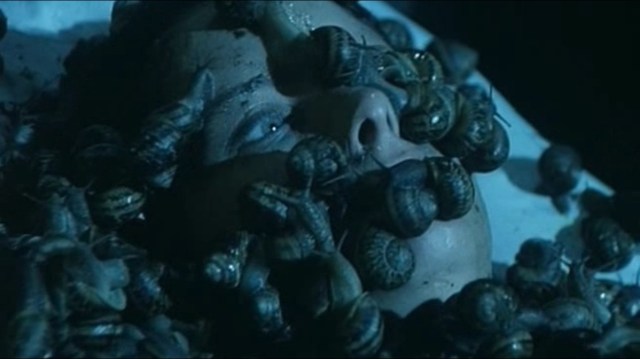
There’s a sleeping girl who suddenly finds her naked body covered with writhing snails that end up suffocating her as well as a painting that oozes blood onto another girl. The presence of posters featuring 80s heartthrobs leads to a lot of unintentional humour, such as one instance where a girl is driven to suicide by the spectre of the coma girl appearing in front of her Top Gun poster. Rarely has the image of Maverick giving the thumbs up been used to such distressing effect.
The whole thing is a load of old bobbins, naturally, but its blurring of logic with illogic lands with Fulcian gusto. There’s enough here to render it memorable at the very least.
Schlock is John Landis’ first film. Made on a shoestring budget while he was in his early twenties, in many ways it provides you with a roadmap that his subsequent career would rarely stray from. Concerning a prehistoric apeman – billed as a Schlockthropus by scientists and the media – who begins terrorising California after being awoken from his centuries-long slumber. He then falls in love with a blind girl and goes on various escapades. Landis never misses the opportunity for a gag, visual or verbal, ensuring it shares the same mischievous rat-a-tat pacing many of his best known films are celebrated for. There’s even a no-budget version of a Blues Brothers cop car chase as well as a love story and ending that feels like a total dry run for An American Werewolf in London.
While widely praised for his 80s work and knack for blending genres, Landis rarely gets his due as a visual stylist but his films are full of arresting images, and many downright iconic ones. Take the first scene in Schlock which fades in on a slowly spinning roundabout with a dead kid draped over it before the camera cranes up to reveal an entire playground of dead kids. The macabre tone is immediately dispelled by a gag, ofcourse, but this opening is nevertheless the work of a gifted filmmaker with a confident eye and a kick-butt sense of how to start a movie. Even Schlock‘s central image of a man in a crude gorilla suit (played by Landis himself with only eye sockets and body language as emotive tools) taps into the charms of a specific heritage of special effect cinema and warms the heart the same way early stop-motion footage does or any B-movie featuring a guy in a rubber suit. It should come as no surprise that special effect extraordinaire Rick Baker got his very first credit on this flick.
At once a delightfully daft collection of humorous vignettes (ala The Kentucky Fried Movie) as well as a loving send up of B-movie cliches, Schlock works as both a comment on the films it pays homage to as well as worthy successor to them. Sure it’s cheap and, duh, schlocky, but it will certainly put a smile on your face. The perfect John Landis debut.
Ferrara is something of a master of lean, mean genre machines that also contain a meaty dose of socio-political spit and furore. Even here, working on a mainstream property for a major studio, he manages to create something that feels his own. Made today, Body Snatchers would be a two hour plus movie but Ferrara gets in and out in under ninety minutes whilst also leaving enough ideas lingering once the credits have rolled. I love the whole idea of the body snatchers and pod people so to see the concept of Jack Finney’s source novel re-jigged and relocated to a military base is pretty ingenious. It’s the kind of smartass high-concept high-wire act screenwriter Larry Cohen is so good at therefore his presence on script duties here is both felt and welcome.
Bonus points on the casting that features the likes of Meg Tilly, R. Lee Ermey and Forrest Whittaker sharing screen time with more deep-cut genre faces like Christine Elise who most people will remember as Andy Barclay’s sassy foster sister Kyle in Child’s Play 2, if they recognise her at all that is. All those slimy practical effects are a joy to watch as well, with Ferrara taking great pleasure in emphasizing the sexual nature of body snatching that was otherwise skimmed over in previous adaptations. Some of that stuff made me feel genuinely queasy, so the movie definitely had its desired effect. Meg Tilly goes all out as well and tips the film over into the kind of freak-out territory you wish more movies of this vein would dip their toes into. Add to that Ferrara’s pointed digs at the military and conformity and you have a pretty substantial hamburger to gorge on.
The first and last line of mother! is “Baby?” Darren Aronofsky is a sick son of a bitch.
For real though, I have not stopped thinking about this movie since seeing it last Friday, so I had to go back for round two. A few things sat a bit awkwardly this time. Like how Aronofsky seems to be making it clear this isn’t taking place in any sense of “proper” reality and yet he still goes to great lengths to keep things grounded in the house/relationship milieu. If you’re going so hard on the metaphor, why the presence of phones? Or like, pots and pans? A washing machine? Is God/Him building this domestic illusion for everyone else to play in, or is it just Aronofsky’s narrative foundation stretched to where the holes are visible? Basically anything that doesn’t have some kind of loaded symbolic meaning feels a bit redundant in that sense. It doesn’t feel entirely thought through and fireproof as a framework. It’s a bit silly.
But all that stuff becomes irrelevant in film’s last hour where the sick thrill of being thrust into such a swirling crescendo of hysteria and lunacy takes prominence over any conceptual nitpicking. It’s like a fucking bungee jump. You just drop and drop and then BOOM you’re jolted in mid-air, left stunned and swaying (the structure perfectly mirrors that exclamation mark in the title in that sense, a deep dive followed by a punch). The film’s last thirty minutes are traumatic in a way I’ve never really experienced before. From the endless invasion that turns into an apocalyptic war-zone to the baby and the beating, the fire and the burnt body, then the ripping out of the heart. Can you believe that after the baby has been eaten and Lawrence has been savaged, Aronofsky even finds room to have her trip down the fucking stairs as she races to the basement? Christ almighty. It just keeps going. It made me feel sick to my stomach. It left me breathless, wordless. A seriously punishing, visceral feat of filmmaking and cruelty that is audacious and committed on a level I’ve rarely encountered before. And I say this as a pretty seasoned movie vet (I survived three August Underground movies). This thing fucked me up good. Twice! I’m playing the long game with this one. Gonna be an all timer for sure.
Also one thing I am obsessed with: What is with that metallic bell (??) sound effect that keeps re-ocurring throughout at key points, especially in Bardem’s office? Is it another Biblical allusion lost on me? I kept trying to figure out if it re-occurs anywhere else. It kind of sounds like the flick of a zippo lighter? But it isn’t quite that. It seems like it should be something hella specific and obvious but I’m at a total loss and dumb. HELP!
So much of modern movie marketing is crazy hyperbole so I might as well get with the times: mother! might just be the best horror film of the century so far, by going exactly where it threatens to with zero fucks given. And also because…it really disturbed me.
This is a cinematic nightmare sustained for two hours. It’s an “EXPERIENCE THIS” kind of movie. The first hour you’ll laugh uncomfortably, half perplexed at what you’re seeng. The last hour is an all-out horror show, a cacophony of madness and hysteria. Baffling, hilariously unsubtle and ridiculous? Sure. But it remains HORRIFYING. The allegory stuff is essential as a way in. Once you “get” what the film is doing it becomes much easier to get on its wavelength and understand certain oddities (a celebrity poet in 2017? Surprise!) It’s all allegory, and not necessarily 2017, or any time at all. It’s not even a fucking house. They aren’t even fucking people.
It’s so much a Darren Aronofsky movie. It’s an overflowing boiling pot of imagery, ideas and themes that permeate throughout his entire body of work. Is his favourite book the Bible? Very likely. This is pretty much the creation montage from Noah blown up to full length with an 18 rating. The thing I love about him as a filmmaker is his willingness to deal in extremes. Most modern horror movies daren’t go as far as the imaginations of their audience. It’s why I have very little time for the current wave of “art horror” movies. They’re all about restraint, suggestion, distant composition, quietness and mood. There have been some great recent movies in that mode from promising young filmmakers, but few to none have stayed with me.
Speaking subjectively, I feel like the best horror movies are the ones that aren’t afraid to go there. The ones I love are the ones that offer a truly visceral experience, for better or worse. When I saw It Comes at Night earlier this year, I bemoaned the movie for being too proud to get its hands dirty and confront the horror of that world head-on, rather than behind obtuse storytelling or locked doors. A film like mother! gives me exactly what I want from the genre, and then some. When Jennifer Lawrence’s character becomes pregnant, because this is a Darren Aronofsky movie, not only do you know that the baby’s bloody demise is a possibility, but that it’s downright inevitable*. He reduces maybe the world’s biggest Hollywood actress to a bruised, battered mess, and shows that battering in all its ugliness. And it’s not for nothing. The film needs it. Aronofsky fucking goes there. The fact he manages it in a major motion picture in the super-sensitive social and political climate of 2017 is even more extraordinary. GODDAMN.
I honestly found this to be one of the most oppressive, perplexing and downright traumatic experiences I’ve had at the cinema. But it’s also fun? And really silly? Horror is where my love of film was originally forged, where most of my cinematic sensibility was crystalised (like that heart Bardem rips out of J Law’s body at the end) and its a genre for which I have an undying affection and attachment to. I’m not sure this is widely considered an all-out horror film by everyone, but I certainly see it as such. For all its allegorical dressing, the film is incredibly simple at its core. That isn’t to say it’s hollow as much as it is straight forward. Once I grasped the various layers of metaphor, my understanding of that part of it was complete and I now find myself swooning over the echo-chamber sound design (the way voices differ in sound as Lawrence travels from room to room is truly immersive) and the three shot rule of the cinematography. In short, mother! is best experienced and to be tormented by rather than discussed and dissected. Let it dissect you. Set me on fire and tear my heart out. I love this movie.
*Remember in Noah when half of the movie was Russell Crowe wanting to kill a baby? Aronofsky, why you hate babies?
Making sequels to movies over twenty years old might be pretty commonplace today but back in the early 1980’s, when Universal decided to produce a follow up to Alfred Hitchcock’s seminal Psycho, it was practically unheard of. Originally conceived as a loose made-for-TV movie starring Christopher Walken as Norman Bates, Psycho II suddenly shifted gears into a major theatrical release when Anthony Perkins read Tom Holland’s screenplay and decided to reprise the role himself. Seeing the finished film, it’s not hard to see why. This is The Norman Bates Show.
Directed by Richard Franklin, who was regularly billed as the Australian Hitchcock (his own Road Games is one of the more ingenious riffs on Rear Window), Psycho II manages to overcome ridiculous expectations by making them a part of the text. So much of this film concerns “regular folk” either quietly willing or actively provoking the newly rehabilitated Norman Bates to get knife happy again. The film’s major coup is that, for all means and purposes, Bates is the victim this time around while Vera Miles’ Lyla Crane, also returning from the original, is the villain. But the filmmakers know damn well the audience are just as eager as Lyla to see him snap and there in lies the film’s tension: will he or won’t he?
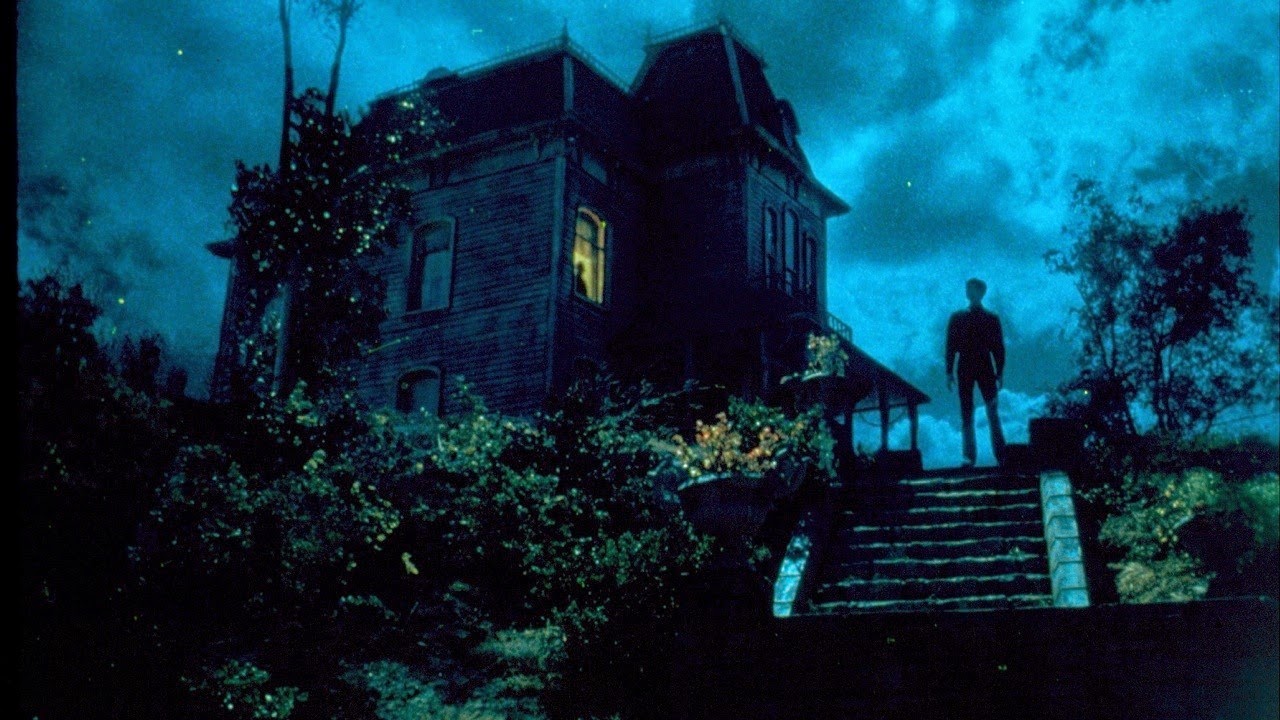
Perkins turns in a great, sympathetic performance full of facial ticks and awkward posturing and you genuinely feel for Norman. Onceyou’ve seen the film and know the outcome, upon rewatch it becomes a tragic tale of a rehabilitated man driven crazy again. The film’s final scene is one of horror’s ultimate rug-pulls. In one swing of a shovel all the iconography of the Psycho universe is suddenly restored back to its status quo. The last shot of Bates stood in silhouette atop the stairs with Mother in the window and an incoming storm thundering on the soundtrack (remember the storm underway when we first meet him in Hitch’s original) gives me chills every time. It’s a victorious moment that gives its audience the sick thrills it has been pining for the entire film.
There are a bunch of winking callbacks to the original Psychobut they feel natural and earned. It is as much a celebration of that film’s legacy as it is a continuation of it. Franklin enjoys playing with his audience’s expectations with multiple fake-outs (Meg Tilly stepping into the shower probably had more audiences bracing themselves than any shower scene before or since). Some of the director’s dark Australian humour seeps in too, paired with much more graphic special effects work giving Psycho II a sticky sweet flavour taking it beyond what Hitchcock could achieve in his day. Jerry Goldsmith’s eerie, melancholic score also goes in its own direction avoiding, for the most part, the shards and strings of Herrmann’s themes. It gives the movie an overall sadder, mournful tone that deepens it into being more about Norman’s fate than a rollercoaster of shocks.
This probably sounds like blasphemy but in many ways I prefer Psycho II to the original. It isn’t a better film – certainly not the classic its predecessor is – but I think about it on a level I don’t with Psycho. How Holland and Franklin took the mythology of that movie and tried to adapt it into a horror franchise model (which wasn’t even a part of the landscape in Hitch’s day) without reverting to cheap shocks or diluting the brand is pretty incredible. There are hundreds of easy, lazy ways to make a Psycho II but the director and screenwriter constantly try harder to make something that really counts and resonates while also deepening and developing its characters. This is a character study in a way the original Psycho never was. Hitchcock’s film is a crucial technical accomplishment, a bravura masterclass in filmmaking technique but it has very little interest in the people once Marion is iced. Norman especially is reduced to a thinly drawn cackling maniac by the end. Psycho might have established Perkins’ Norman Bates as one of horror cinema’s most iconic murderers, but the reason we now have countless sequels, spinoffs, reboots and TV shows set within this universe is because Psycho II showed there was a lot more to be mined there. This is the film that made you care about Norman Bates.
You want to know how inventive this movie is? It gets to a point where a shot of Jason Sudeikis’ feet slamming on a playground equates to the deaths of thousands of people in your imagination with just a gentle helping of sound design. That’s when you know Vigalondo’s gambit is paying off. Why stage mass-destructon when he can get the audience to do it for him? That’s good shit.
Maybe the best showcase of Hathaway’s talent since Rachel Getting Married which proves she works best when working with frayed edge characters. Though I read somewhere she was pregnant while filming this so I couldn’t help but constantly notice the presence of baggy clothes and obtuse framing and I also kept adding her pregnancy into the actual story as some sort of unspoken subtext, which added more danger and sympathy to her character, then I had to remind myself that no, she isn’t supposed to be pregnant at all. Still, pregnant or not, she is so radiant and present in this movie. One of those performances that engages you and has you musing within “she’s a great actress”. Sudeikis too is used to wonderful effect. It’s a role that tunes into both sides of his prickishness; the likeable prick and the detestable one. It feels like stunt-casting in that his acting persona is so much a part of the impact of the character’s arc.
Conceptually, there’s a lot to chew on here. Lot’s to read into. The film works as a comment on toxic relationships, online hate culture or even America’s fascination with mass destruction as entertainment. It all amounts to the best Vigalondo flick since Timecrimes certainly. It feels like it was inspired by child-like fantasy and imagination; a film that is built on a very simple idea and carefully sustains it. It’s surprisingly dark but the concept feels genuinely fresh, original and relevant. It’s like a skewed blockbuster, a film that manages to feel gargantuan despite having the most modest stature. At one point somebody asks, “Do you want to hear an amazing story?” Colossal qualifies as such.
And so begins Kathryn Bigelow’s Strange Days, which proceeds in the form of a dizzying and glitchy POV shot that plunges you head-first into a high-wire robbery sequence before dropping you off the top of a building. Mixing Blade Runner-esque futurism with screenwriter James Cameron’s penchant for tech-noir and the cinematic language of video games, this underrated 90s cyberpunk thriller is nothing less than a masterclass in futuristic world-building.
For all the great movies under Cameron’s belt, I’d definitely wager that this is his best screenplay. Maybe the fact it was co-written by Jay Cocks has something to do with it – the only film Cocks hasn’t written for Martin Scorsese – but I suspect Cameron was freed of any worries of directing it himself and felt liberated to create something more subversive with a harder edge than the kind of film his position as a mainstream, colossal-budget filmmaker would usually allow for.
The central concept of a SQUID device – a program that allows users to record, share and feel memories – is fully explored. Despite the endless potential of the idea, Bigelow and Cameron somehow seem to cover all the bases. The exhilarating thrill is displayed in that first shot, the sexual side is repeatedly addressed and the dark and depraved dangers aren’t shied away from. One of the many elements of the chaotic plot features a serial killer who forces his victims to experience their own sexual assault and death through his eyes by making them wear a SQUID headset synced up to his cerebral cortex. Now that is an incredibly fucked up and vivid idea, executed by Bigelow with suitably visceral nastiness and that stuff really stays with you. This is a film full of ideas – cluttered with them in fact – that are both thrilling and unnerving.
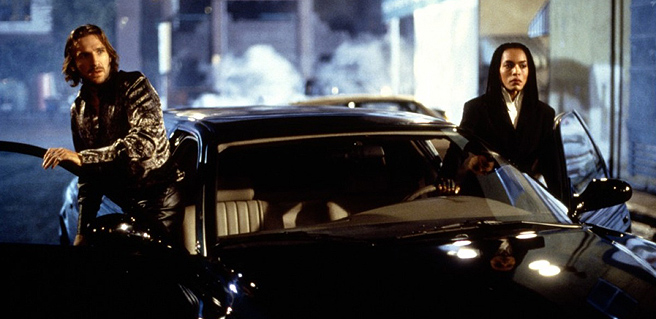
The plot is definitely the least interesting thing about Strange Days and once the murder mystery and political undertones (the police brutality subplot feels like a direct response to the Rodney King incident) give way to a disappointingly formulaic third act, you learn to enjoy the movie for its immersive elements alone; the performances, the production design and the cinematography. Remember when Ralph Fiennes was briefly courted as an action movie star? As Lenny Nero he gets a hell of a lot of mileage out of a shit-eating grin and punching-bag charm. There’s also Juliette Lewis slap-bang in the middle of her fierce 90s mode, channelling not only her gifts as a spiky hellcat but as a future rock star. And if you thought the cast couldn’t get any more 90s, remember this thing also stars Tom Sizemore (that fucking wig), Angela Bassett, Vincent D’Onofrio and Michael Wincott. Oh and you know the central refrain of Fatboy Slim’s “Right Here, Right Now”? Sampled from this movie!
Made in 1995 but set in a then-futuristic 1999, Strange Days works as a fascinating time capsule of pre-Millennium paranoia about technology. The lovely fetishisation of analogue technologies like Mini Discs brings a lot of nostalgia, though with VR tech getting more advanced by the day, the film’s themes feel, strangely, more relevant and vital now than it probably did in 1995. Technically this is a period piece set in a 1999 that never was in the same way that Richard Kelly’s Southland Tales squinted into 2008 from the vantage point of 2006 and created an alternate reality in the process. Bigelow has never made another film this ambitious or fantastic and her exit from contemporary, big-budget genre cinema in favour of gritty, political documents is a massive loss. I also admire Cameron for to turning over the best thing he’s ever written to a female director he knew could do it better than he ever could (and I’m a JC fanboy). This movie rules.
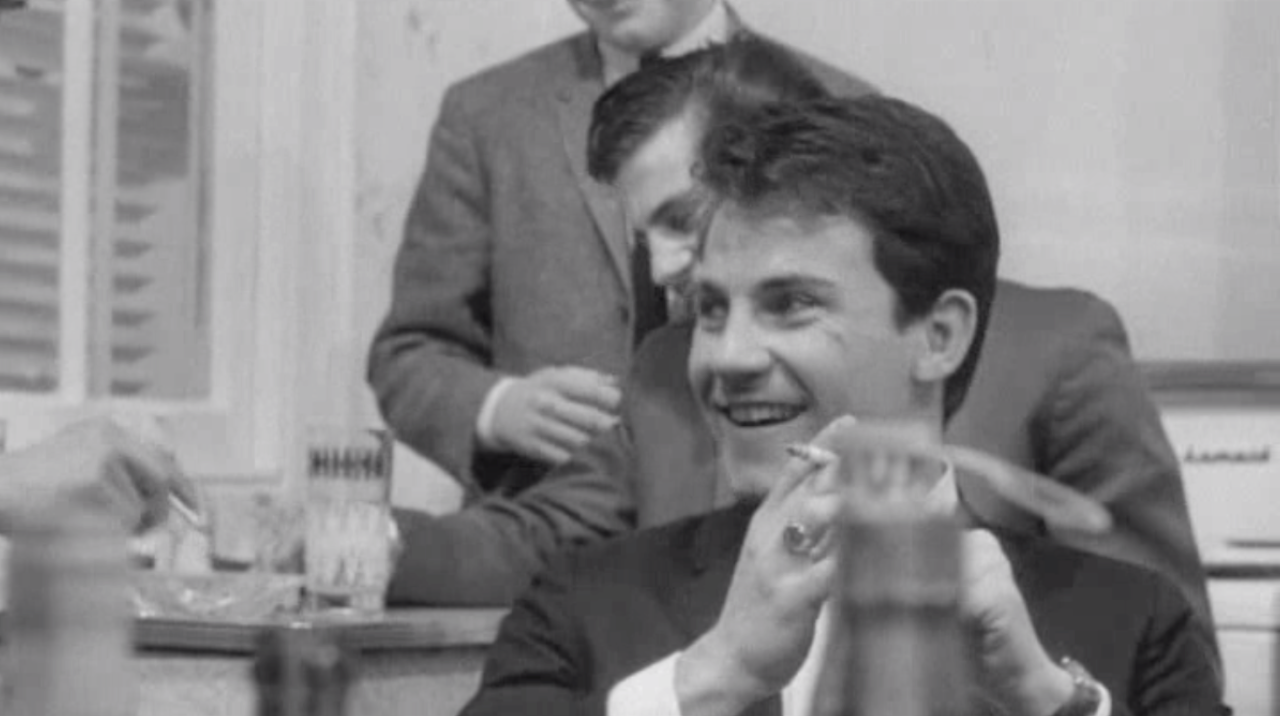
I can’t be the only one who assumed Desperado was Robert Rodriguez’s second movie following El Mariachi, making the existence of this giddy little made-for-TV movie a nice surprise. Conceived of and shot in the interim between his breakthrough movies, Roadracers was intended as a training ground project to help Rodriguez transition from being a one-man crew to being in charge of an actual team of collaborators. He wrote it based on an eclectic stewing pot of influences he wanted to indulge in. So: 50s greasers, B-movies, hot rods, beautiful women, kinetic violence and rockabilly music with a fetishistic emphasis on guitars. A Robert Rodriguez movie, basically.
And I’m totally down for that! Like Rodriguez, I love sensations and Roadracers is full of ’em. The wind in the faces of the kids as they drive their cars at night, the screech of rubber on asphalt, the slop and squish of a tub of hair grease smothered endlessly over black hair, smoke rings and the lightning strike editing of a band jamming out their hottest tune; all of these images are delivered with emphasised sound design and punch. As with most of Rodriguez’s movies, Roadracers exists in a malleable, cartoon reality; a pop culture-saturated universe brought to life with a child-like sense of giddiness that makes even its cheapest tricks pleasurable. A farce-like chase in an ice-rink for example, or a winking cameo from Invasion of the Body Snatchers star Kevin McCarthy (watching his own film, no less) just add more colour to the comic strip.
Stars David Arquette and Salma Hayek, both appearing in two of their earliest roles, exude a lot of youthful energy and sexiness. Arquette has a devilish glint in his eye which Rodriguez milks for all he can while Hayek – with all her jaw-dropping beauty and charisma – shows why she was destined for super-stardom. One sequence featuring the two dancing to rock n’ roll, completely kitted out in 50s duds with 50s surroundings, is worth the price of admission alone. John Hawkes even pops up as the B-movie obsessed best friend. Although, you can’t escape the fact that a lot of this is just surface pleasures.
For all the thrills a wide-eyed sugar rush delivers, there’s always a bit of a comedown. A few scenes here and there fall flat and Rodriguez’s seeming inability to just slow things down or settle for a few minutes undercuts some emotional beats. There’s also an iffy subplot played for laughs involving one poor girl being repeatedly humiliated and tormented – her hair is set on fire during her first scene, and that’s just for starters – that feels needlessly cruel and tonally misjudged. But these missteps don’t derail the film entirely.
The film looks great and is full of good looking people and good looking things (those cars, the jukeboxes, the outfits). It’s very stylish and alive; much better than its non-reputation would suggest. Clearly made at a lightning pace and intended to be devoured like junk food, it’s hard to knock a movie that works exactly how it means to. A worthy and playful chapter of the Rodriguez canon even if it’s the filmic equivalent of an obscure bonus track.
As much as I loved Skyfall the film’s insistence on slowly undoing all of Casino Royale‘s franchise retooling – bringing Q and Moneypenny back into the game as well as a curmudgeon old white guy into the M role and re-injecting more of the sly humour – seemed to put whatever mission that followed on bad footing. After seeing Spectre twice now I’m even more convinced that those creative decisions were entirely misjudged.
Mendes returning to the director’s chair and the promise of finally seeing a Craig-era take on S.P.E.C.T.R.E and Blofeld was enticing but it becomes pretty clear pretty fast that all the enthusiasm and class Mendes brought to Skyfall has become somewhat exhausted by dedicating up to five years of his life on this franchise. For so much of the running time, this just feels like Bond by the numbers.
The semi one-take pre-credit sequence comes across like hollow showboating; it’s immediately obvious they didn’t actually do it all in one take and it has very little dramatic purpose, so why bother? The thin plotting is made unnecessarily complicated too and there’s just a bunch of dumb moments. At one point a mouse helps Bond find a secret room. Come on! The female character problems that have always plagued the series come crashing back into play after being mostly avoided for the last few films with Monica Bellucci’s doomed widow. She has little narrative use beyond being de-robed and bedded by Bond, making you think aloud “what year is this?” Much was made of her being an “older Bond girl” but even if you had Craig seducing Dame Maggie Smith, the nobility of that decision would still be cancelled out by the underwriting.
More than anything I’m still pissed about the stupid game the marketing team tried playing with Waltz’ casting. As soon as he was announced as “Franz Oberhauser” everyone rightly guessed it was merely an alias for Ernst Stavro Blofeld. First off, what a boring, obvious casting choice. Secondly, didn’t Stark Trek Into Darkness teach these marketing guys anything? Why be coy about it? When they released the first teasers with Waltz in shadow ominously promising Bond he was “the author of all your pain” – confirming him as Blofeld, basically – the teasing was so blatant that I assumed they were playing up to expectations and secretly planning a bait and switch, an assumption I carried throughout my entire first viewing.
As Spectre slowly inched towards its climax I suspected that Lea Seydoux’s mostly unremarkable Bond femme-in-distress Madeline Swan was going to be revealed as the real Blofeld, which made most of my trepidations in the plodding second act tolerable. As a life-long Bond fan, I became incredibly excited about this concept which was totally in-tune with the kind of bold retconning these Craig movies promised all the way back in 2006. Bond having a female arch nemesis over various movies, how cool would that be? So much potential. It would also explain why they cast such a terrific actress in such a thankless role. Alas, as soon as Waltz hams it up and reveals his true identity any hope I had for this regular old Bond movie to morph into something irregular was instantly extinguished.
This is followed by a silly fourth-act involving a ticking clock game of cat and mouse in a bombed-out MI6 (a cool location!) that feels like something out of any other generic spy thriller, a category these movies should constantly be striving to be better than. The schmaltzy “driving off into the sunset in the Aston Martin” tag also feels like it was dropped in from a totally different movie. Not only does it succumb to the kind of classic-Bond nostalgia that worked in Skyfall but should otherwise be avoided at all costs (see Die Another Day), it also goes against the overreaching arc established from Vesper’s death in Casino Royale of Bond being forever doomed to be alone. Also, Craig and Seydoux just don’t have that much chemistry, making the beat land on even more of a bum note. There are whispers that this is setting up the next chapter as a Craig era On Her Majesty’s Secret Service, which is certainly intriguing, but given the way this movie totally sidelines dramatic potential in favour of stock beats, I’m hesitant to get my hopes up.
So why the relatively positive rating? Well I still love Craig’s take on this character and the technical side of things almost makes up for a lot of the script’s downfalls. Shot on celluloid by ace DOP Hoyte van Hoytema (stepping in for Roger Deakins who lensed Skyfall beautifully with digital cameras) the film is full of stunning vistas and a chilly colour palette that renders so many stock scenes in alluring shades of shadow and hues. The cast is great across the board too and all make the most out of what they’re given. Let’s just hope the next one – Craig’s last? – gets things back on sure footing.



/cdn.vox-cdn.com/uploads/chorus_image/image/58156035/mother.0.jpg)

 Making sequels to movies over twenty years old might be pretty commonplace today but back in the early 1980’s, when Universal decided to produce a follow up to Alfred Hitchcock’s seminal Psycho, it was practically unheard of. Originally conceived as a loose made-for-TV movie starring Christopher Walken as Norman Bates, Psycho II suddenly shifted gears into a major theatrical release when Anthony Perkins read Tom Holland’s screenplay and decided to reprise the role himself. Seeing the finished film, it’s not hard to see why. This is The Norman Bates Show.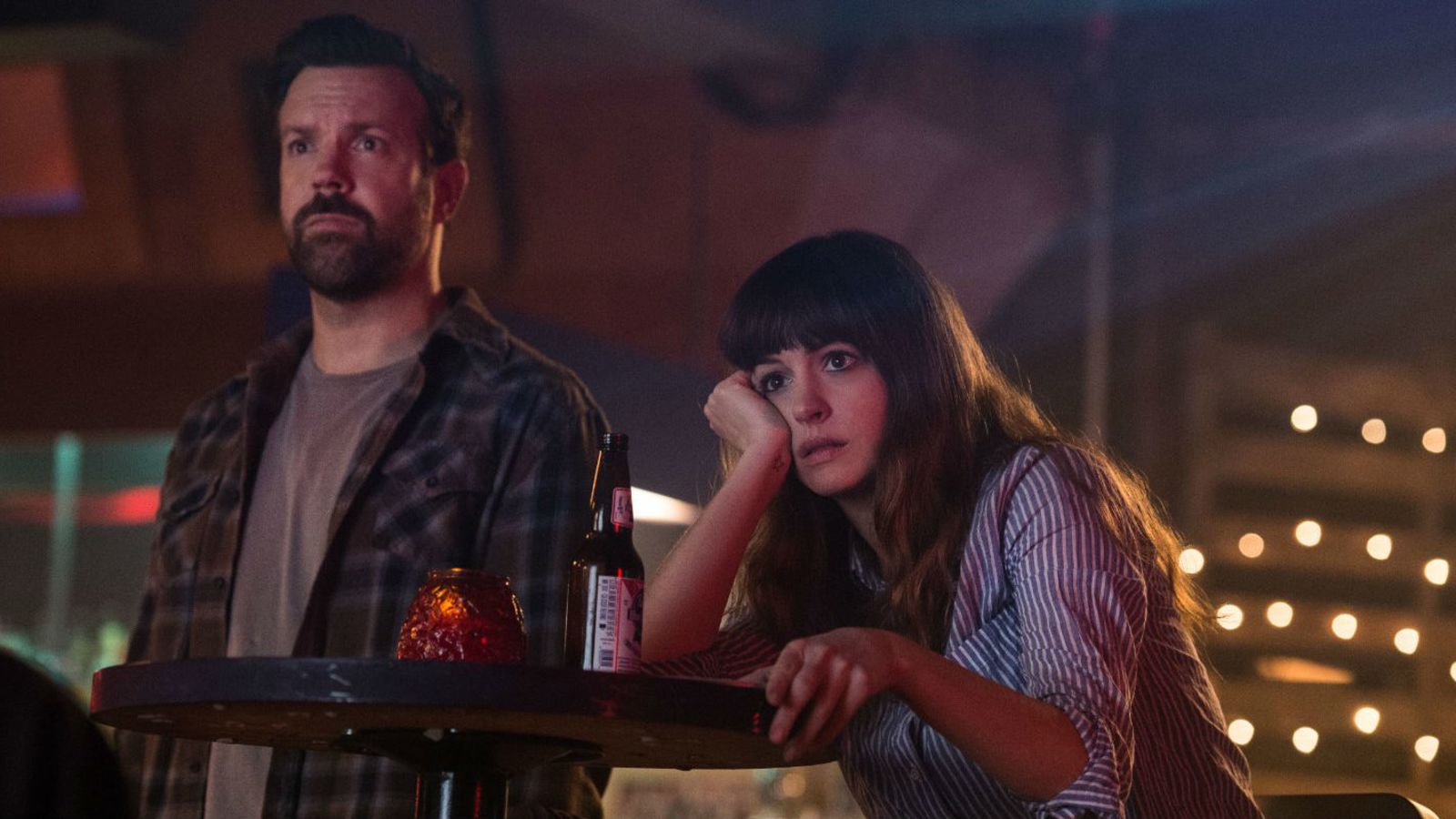




 "This Film Should Be Played Loud"